- Type
- Lesson plan
- Subject
- Math
- Topics
- Math & Economics
- Ages
- Ages 8-13
- Duration
- 45 min
- Level
- Beginner
- Includes
- Quiz: 5 questions
How can we identify, classify, and construct different geometric shapes and measurements in an interactive environment?
Overview
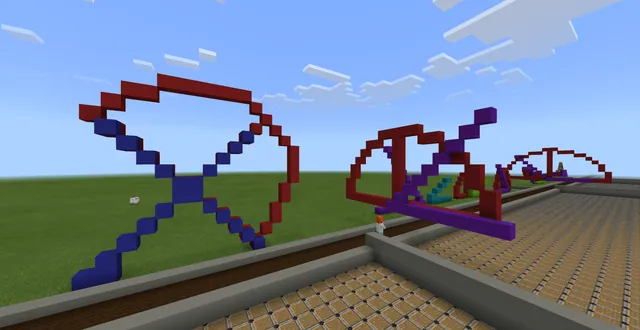
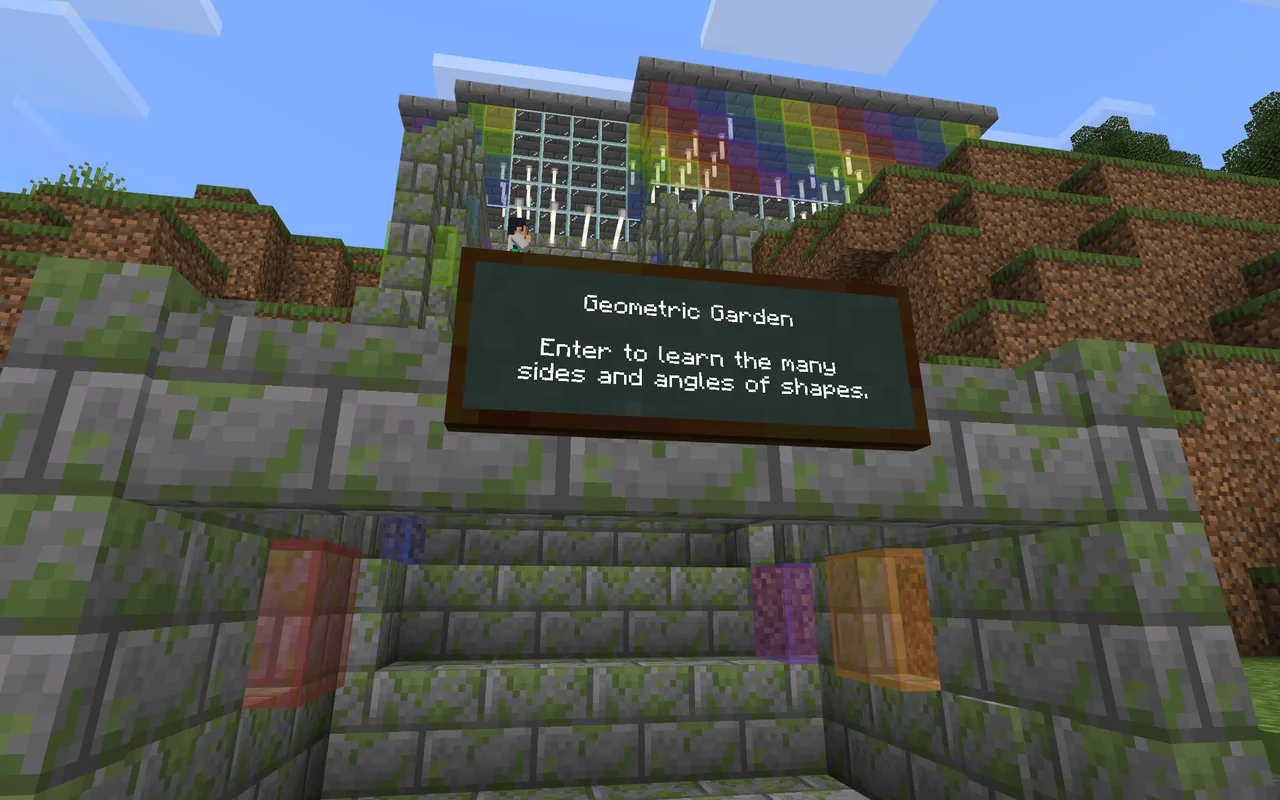
This lesson serves as an interactive extension to standard geometry instruction, helping students visualize geometric properties and spatial measurements. Learners explore foundational concepts including polygon attributes, triangle classifications by sides and angles, and spatial concepts of area and volume.
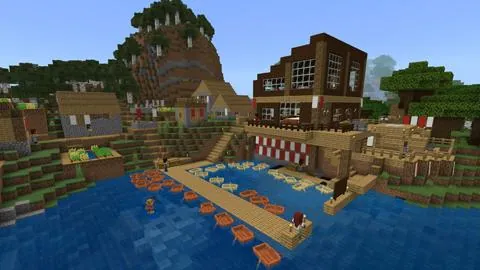
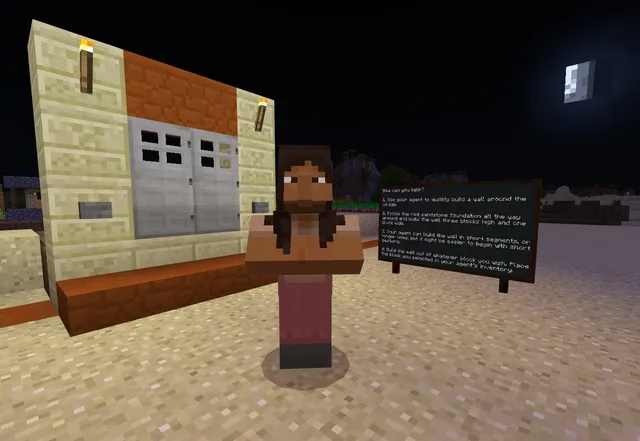
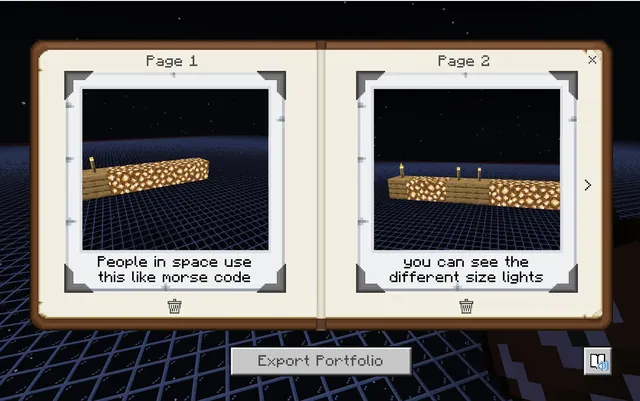
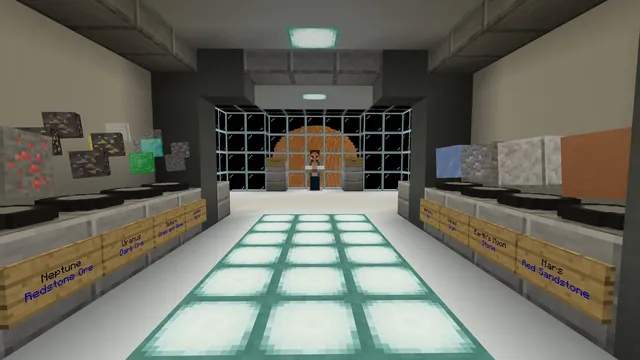
Inside the Minecraft world, students interact with non-player characters to guide their exploration across four themed zones. Using an in-game Camera and Book and Quill, learners photograph examples, record their observations, and build their own geometric constructions to demonstrate understanding.
Learning objectives
By the end of this lesson students will be able to:
- Identify and classify various polygons based on their properties.
- Classify triangles according to their side lengths and angle measurements.
- Explore concepts of area and volume across structured in-game zones.
- Document geometric findings and custom constructions using the Camera and Book and Quill.
Blocks and items used in this lesson


Key vocabulary
- Polygon
- A closed two-dimensional shape formed with straight line segments.
- Area
- The measurement of the two-dimensional surface space inside a shape.
- Volume
- The amount of three-dimensional space enclosed within an object.
- Triangle Classification
- Sorting triangles into groups according to their side lengths and angle types.
Before class
Lesson sequence
Suggested timing: about 45 minutes in total.
- Introduction and World Orientation10 min
Connect the lesson to current classroom geometry topics. Instruct students to load the world and talk to the starting non-player character to collect their Camera and Book and Quill.
- Zone Exploration and Discovery20 min
Students visit the designated learning spaces to explore area and volume, polygons, and triangle classifications. Learners speak with guiding NPCs and use their Camera to capture examples of each geometric concept.
- Geometric Construction10 min
Students enter the designated building area to construct their own geometric figures. They take photos of their builds and log explanations of sides, angles, or measurements into their Book and Quill.
- Export and Assessment5 min
Have students sign and export their Book and Quill files, then submit them through the standard classroom workflow for teacher evaluation.
Assessment: success criteria
- Accurate classification of polygons and triangles documented in the exported portfolio.
- Correct application of area and volume concepts shown in notes or screenshots.
- Completion of an original geometric build meeting shape criteria.
- Submission of an exported Book and Quill containing photographs and written descriptions.
Differentiation
Pair students together to navigate the zones and provide a checklist of specific shapes and triangle types to locate.
Challenge learners to construct complex figures combining multiple polygon types and calculate their total surface dimensions.
Knowledge check
5 questions to check understanding after the lesson. Tap an answer to see if it is right; the score appears at the end.
1Which items does an early NPC provide to help students record their work?
Answer: B. An NPC near the start provides learners with a Camera and a Book and Quill for documentation.
2How many distinct learning spaces can students choose to explore in this world?
Answer: C. The world includes four distinct spaces covering area and volume, polygons, triangles, and construction.
3Which geometric shape is classified in this world according to both sides and angles?
Answer: B. The lesson specifically covers triangle classifications based on their sides and angle measurements.
4How do students share their completed work with the teacher for assessment?
Answer: C. Students export their Book and Quill file so the teacher can assess their learning.
5Besides polygons, triangles, and building, which mathematical topics are explored in one of the zones?
Answer: A. One of the four world sections is dedicated to learning about area and volume.
Frequently Asked Questions
How do students export their completed work?
Students open their Book and Quill, sign the book, and select the export option to save their documentation as a file ready for teacher submission.
Is this lesson intended to replace direct geometry instruction?
No, the lesson is designed as an extension activity to reinforce and apply geometry standards introduced during teacher-led classroom instruction.
Adapted from Geometric Garden by Andy Knueven on Minecraft Education, last updated Aug 7, 2025. This classroom version, the timings and the quiz were written by 9Minecraft Education.