- Type
- Lesson plan
- Ages
- Ages 8-13
- Duration
- about 60 min (suggested)
How do daily spending decisions, budgeting, and payment methods impact long-term financial stability?
Overview
Managing personal finances requires individuals to differentiate between essential needs and non-essential wants, understand the impact of credit and debt, and design budgets that maintain stability. In this lesson, students explore real-world economic decision-making by balancing monthly income against recurring costs such as housing, transportation, and everyday lifestyle purchases.
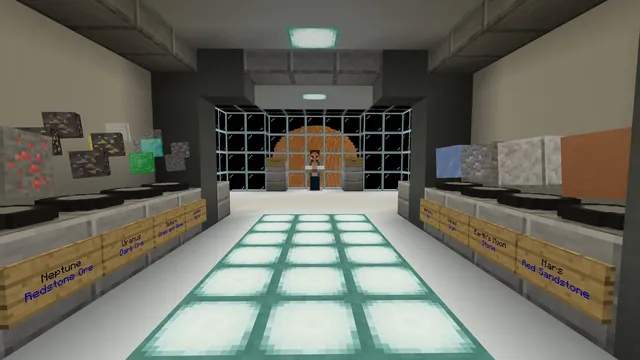
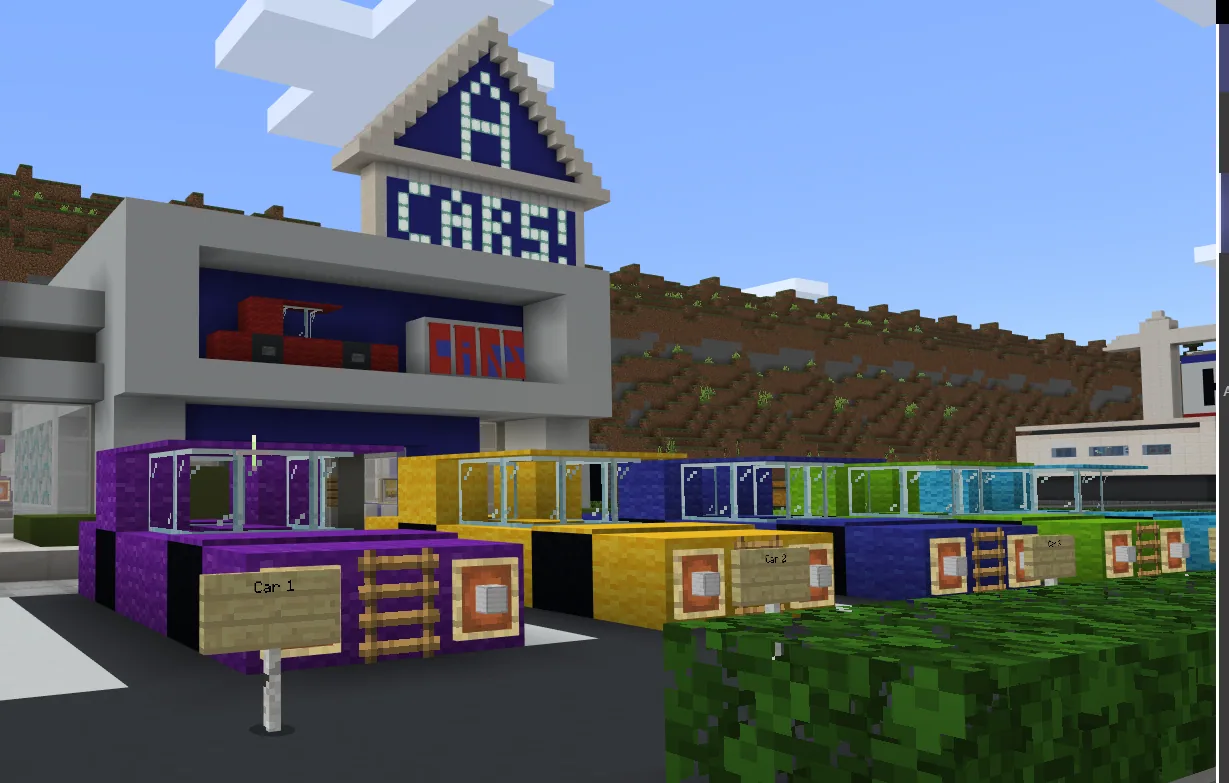
Using a custom Minecraft town featuring a bank, shopping plaza, auto mall, and residential areas, students navigate financial choices independently. The world calculates passive income and living expenses automatically, prompting learners to document their purchases with a camera and Book and Quill before concluding their financial cycle at City Hall.
Learning objectives
By the end of this lesson students will be able to:
- Design a functional budget to allocate monthly income between essential and non-essential expenses.
- Explain the differences and trade-offs between paying with cash, using savings, and borrowing with credit.
- Calculate unit rates and determine value when choosing between buying, renting, or leasing goods.
- Document financial transactions and evaluate the consequences of spending choices.
Blocks and items used in this lesson


Key vocabulary
- Budget
- A spending plan that balances expected income against anticipated expenses over a specific period.
- Essential Expenses
- Necessary costs required for basic living, such as groceries, shelter, and transportation.
- Non-Essential Expenses
- Optional purchases for items or activities that are not required for survival, such as entertainment and pets.
- Credit
- A financial agreement that allows a buyer to obtain goods or services immediately and pay for them later.
- Savings Account
- A bank account designated for holding money safely aside for future needs or unexpected expenses.
Before class
Lesson sequence
Suggested timing: about 60 minutes in total.
- Introduction and Pre-Budgeting10 min
Introduce the financial scenario to students: each month, they receive an income of 2,304 gold. Lead a brief discussion distinguishing essential expenses like food, shelter, and transit from non-essential wants like fast food, entertainment, and pets.
Have students draft a preliminary budget outlining how much of their earnings they intend to spend on necessities versus luxury items.
- World Orientation and Banking10 min
Students load into the world and speak to the starting Non-Player Character to begin the simulation and collect a camera. Direct students to locate the bank early in their session to explore opening savings and credit accounts.
- Open Simulation and Purchases20 min
Learners explore the shopping plaza, auto mall, model homes, and residential neighborhoods. As in-game systems manage automated income and deductions, students decide whether to lease or purchase goods, buy homes or vehicles, and pay out-of-pocket or via credit.
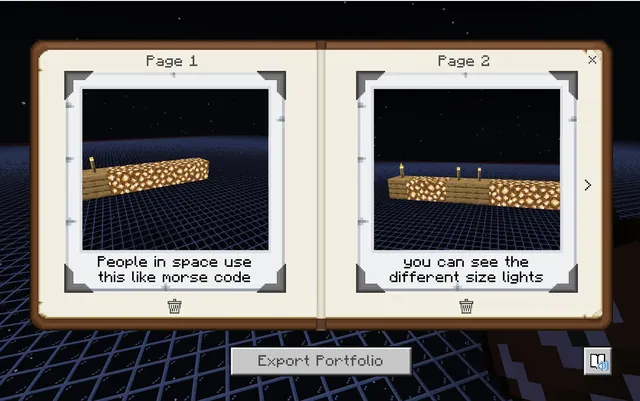
Students use their camera and Book and Quill to document every major transaction and record their remaining funds throughout the process.
- City Hall and Account Balancing10 min
When exploration time expires, instruct all students to report to City Hall. Speaking with the Non-Player Character inside City Hall halts passive income and automated deductions.
Students total their remaining gold. Those who fully purchased houses or vehicles may choose to sell them back to calculate their total net worth.
- Class Reflection and Debrief10 min
Gather the class to compare results using the guided reflection questions. Discuss the consequences of running out of money, the advantages and risks of credit accounts, and whether renting or buying assets proved to be the better financial strategy.
Assessment: success criteria
- The student constructs a realistic monthly budget that categorizes essential versus non-essential spending.
- The student documents their purchases, payment methods, and financial balance using the camera and Book and Quill.
- The student explains the practical differences between using out-of-pocket cash, savings, and credit cards.
- The student evaluates whether buying, leasing, or renting assets was financially advantageous during the simulation.
Differentiation
Provide a pre-printed spending log with pre-labeled categories for essentials and non-essentials to help students track transactions.
Have students repeat the simulation to test an alternate financial strategy, such as prioritizing credit building or maximizing savings, and compare final outcomes.
Knowledge check
5 questions to check understanding after the lesson. Tap an answer to see if it is right; the score appears at the end.
1How much gold do players earn as their monthly income in the simulation?
Answer: C. The source states that players earn 2,304 gold every month, representing a player's maximum inventory capacity.
2Where must students go to stop recurring income and expenses at the end of the simulation?
Answer: A. Speaking to the Non-Player Character inside City Hall halts the passive income and expense cycles.
3Which tool can students obtain from the starting NPC to record their decisions?
Answer: D. Students can take a camera from the initial NPC to photograph their experiences and choices.
4Which of the following is categorized as an essential expense in the lesson?
Answer: B. Groceries, shelter, and transportation are listed as essential living expenses in the guiding questions.
5What option do players have at the end of the activity if they bought a house or car?
Answer: C. The source notes that players who bought their house or car can sell them at the end to gain extra funds.
Resources
- Lesson package (.zip)Everything the author attached to this lesson in one download.
- Teacher Preparation NotesA document that outlines important notes to consider when facilitating the activity.
- Financial Literacy World Lesson PlanA document that includes all of the information needed for the Financial Literacy World activity.
Frequently Asked Questions
How do students track their spending and passive cash deductions?
Income, purchases, and expenses are calculated automatically by the in-game systems, allowing students to focus on making decisions and logging transactions using the camera and Book and Quill.
Can students re-run the simulation to test different choices?
Yes, students are encouraged to replay the world multiple times to experiment with different budgeting models, payment methods, and asset purchases to observe how their outcomes change.
Adapted from Financial Literacy World Gr. 5 by Blaise Patterson Patterson on Minecraft Education, last updated Nov 23, 2020. This classroom version, the timings and the quiz were written by 9Minecraft Education.