How can the buildings and functional roles within a village represent the jobs of organelles in plant and animal eukaryotic cells?
Overview
Learning the roles of eukaryotic cell organelles can feel abstract, but relating them to community infrastructure helps students grasp how cellular parts collaborate to sustain life. In this project, learners explore how specialized structures within a living cell operate much like the functional services in a human town.
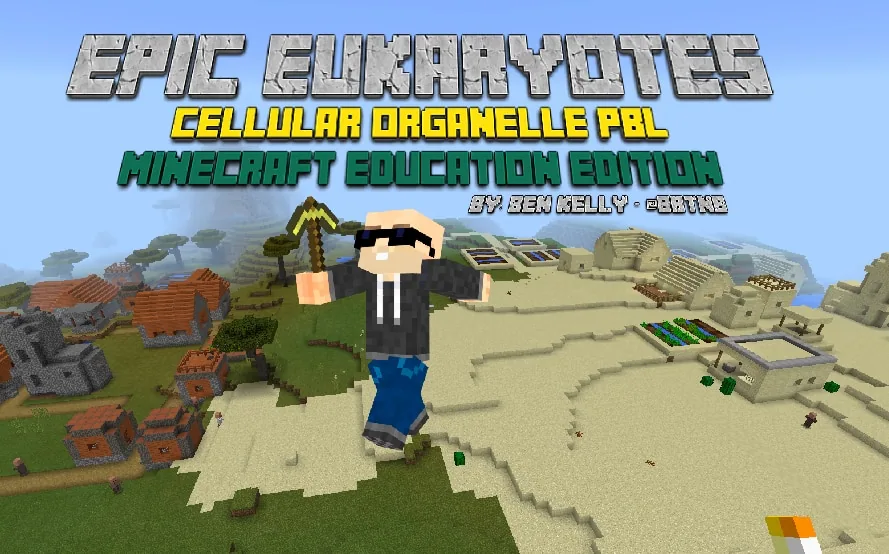
Students work in teams within Minecraft, exploring either a plant-themed village (Veggieville) or an animal-themed town (Beefburg). By identifying municipal buildings that mirror cellular jobs and adding functional in-game items, students create an interactive, spatial model of eukaryotic cell biology.
Learning objectives
By the end of this lesson students will be able to:
- Research the roles and properties of organelles found in plant and animal eukaryotic cells.
- Identify village structures that correspond to specific cellular organelles based on functional similarities.
- Enhance selected village locations with in-game items that illustrate how those organelles operate.
- Explain the similarities, differences, and functional relationships between chosen village sites and cell organelles.
Blocks and items used in this lesson


Key vocabulary
- Eukaryotic Cell
- A complex type of cell that contains a nucleus and membrane-bound organelles, characteristic of plants and animals.
- Organelle
- A specialized subunit within a cell that carries out a specific biological task.
- Vacuole
- A cellular storage organelle responsible for holding water, nutrients, and waste materials.
Before class
Lesson sequence
- Organelle Research
Students research the functions and properties of eukaryotic organelles in both plant and animal cells, recording structured notes on how each structure contributes to cellular life.
- Village Exploration and Mapping
Teams enter their assigned settlement, either Veggieville or Beefburg. Working together, they survey the town layout to locate buildings whose civic roles match the biological duties of specific organelles.
- Site Enhancement
Learners place relevant in-game objects inside or around their chosen sites to strengthen their analogy. For example, students representing a vacuole might furnish a local bank with storage chests full of resources.
- Analogy Defense and Reflection
Each team articulates why they paired specific town structures with particular organelles, explaining both the similarities that support the match and the differences between the cell and the town.
Assessment: success criteria
- Comprehensive research notes outlining eukaryotic organelle roles in plant and animal cells.
- Logical pairing of village buildings with corresponding cellular organelles based on real biological function.
- Effective addition of in-game items that demonstrate the operational role of the represented organelle.
- Clear verbal or written explanation highlighting both similarities and differences between the town site and the organelle.
Differentiation
Provide an organelle reference sheet that pairs cell functions with helpful municipal hints to guide building selections.
Have students compare the functional differences between Veggieville and Beefburg, explaining why certain structures exist only in the plant-based settlement.
Knowledge check
5 questions to check understanding after the lesson. Tap an answer to see if it is right; the score appears at the end.
1What major cell type do students investigate during this community project?
Answer: B. The lesson specifically focuses on plant and animal eukaryotic cells.
2Which organelle is suggested to be modeled by placing resource-filled chests in a town bank?
Answer: C. The source provides the bank with chests of resources as an example of a vacuole storing materials.
3What are students expected to do inside Minecraft to reinforce their organelle comparisons?
Answer: A. Learners place items, such as resource chests, inside the locations to visually and functionally support their analogy.
4Which two villages are used to model plant and animal cells in the activity?
Answer: B. The source specifically names Veggieville and Beefburg as the two settlements students explore.
5When explaining their matches, what key details must students articulate about each location and organelle?
Answer: C. The learning goals explicitly state that students must articulate the similarities and differences between the organelle and the chosen town location.
Resources
- Lesson package (.zip)Everything the author attached to this lesson in one download.
- title cardtitle card
- screen shot 1ss1
- screen shot 2ss2
- screen shot 3ss3
Frequently Asked Questions
Does this lesson include a downloadable Minecraft world file?
No custom world download is included. Teachers can use naturally generated villages in standard Minecraft worlds and designate them as Veggieville or Beefburg.
What grade levels are suitable for this organelle project?
The source lists this activity for all ages, allowing teachers to adapt the biological depth from basic cell part identification to detailed metabolic functions.
Adapted from Epic Eukaryotes by Benjamin Kelly on Minecraft Education, last updated Jan 30, 2017. This classroom version, the timings and the quiz were written by 9Minecraft Education.