- Type
- Lesson plan
- Subject
- Math
- Topics
- Math & Economics
- Grade
- Primary (Grades 3-5)
- Ages
- Ages 8-10
- Duration
- about 85 min (suggested)
How can visual math arrays help us understand the commutative property of multiplication and design strategic structures?
Overview
This lesson introduces students to the commutative property of multiplication, emphasizing the core concept that multiplication problems yield the same product regardless of the order of factors. By analyzing paired equations and number families, students discover that factors can be multiplied forward or backward without changing the outcome.
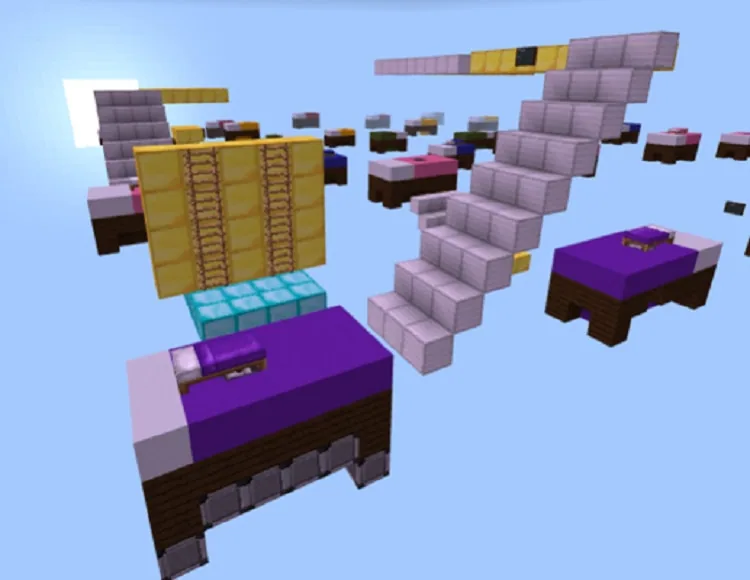
Using Minecraft Education in Creative mode, students construct math models as bridges and defensive terrain for a Bed Wars mini-game. Learners examine each other's builds through a structured peer review using slates, verify mathematical accuracy, and engage in extended gameplay that connects spatial design with mathematical reasoning.
Learning objectives
By the end of this lesson students will be able to:
- Build six Minecraft math models illustrating pairs of commutative multiplication equations.
- Record math model sketches, equations, and number families in a math notebook.
- Peer review classmates' math models by inspecting arrays and labeling them with slates.
- Apply math models strategically as pathways and base defenses in a Bed Wars mini-game.
Blocks and items used in this lesson


Key vocabulary
- Commutative Property of Multiplication
- A mathematical rule stating that changing the order of factors does not change the product (for example, 4 × 5 = 5 × 4).
- Number Family
- A set of related numbers that connect through specific multiplication and division facts.
- Array
- A grid of blocks or items arranged in equal rows and columns to represent a multiplication equation.
Before class
Lesson sequence
Suggested timing: about 85 minutes in total.
- Opening Slideshow and Guided Discussion15 min
Present the opening slideshow displaying Minecraft math models. Guide students through a discussion analyzing how model pairs relate to one another and how to identify their number families. Have students record drawings of the models, corresponding equations, and number families in their notebooks before revealing that multiplication equations remain the same forwards and backwards.
- Sky Map Math Construction25 min
Direct students into the Minecraft world in Creative mode. Working alongside teammates assigned to the same bed color, students construct six math models representing commutative multiplication pairs (such as 4 × 5 = 20 paired with 5 × 4 = 20). Students place these models strategically to form bridges to opponents or defenses around their bed, adhering to the rule that beds must never be fully encased and must have an open entrance.
- Peer Review and Verification15 min
Have students fly across the map to inspect their classmates' builds. Reviewers examine each model, place a slate, and write their name along with the equation they see represented. If a reviewer identifies a different equation than the original builder, students collaborate to resolve the discrepancy before moving forward.
- Math Bed Wars Mini-Game30 min
Begin the Math Bed Wars match. Students utilize their completed arrays as physical pathways and defensive barriers to defend their beds and navigate toward opponents. Allow at least 30 minutes for gameplay so students can see their strategic math models in action.
Assessment: success criteria
- Student builds and explains six Minecraft math models demonstrating the commutative property of multiplication.
- Student labels math models with correct equations using in-game slates.
- Student inspects and peer-reviews at least six classmate models to verify mathematical correctness.
- Student incorporates purposeful design by using models strategically during the mini-game without fully walling off beds.
Differentiation
Allow learners to draft their arrays on graph paper first to count out dimensions before placing blocks in the game.
Challenge students to incorporate higher-factor multiplication pairs into complex multi-tiered bridge designs while keeping the arrays distinct.
Knowledge check
5 questions to check understanding after the lesson. Tap an answer to see if it is right; the score appears at the end.
1What core idea does the commutative property of multiplication show?
Answer: A. The source identifies the big idea as: multiplication problems are the same backwards and forwards.
2What rule must students follow when building around their team's bed?
Answer: B. The building guidelines state 'no bedrooms', meaning players cannot fully encase their bed and must leave at least one way in and out.
3How many commutative math models is each student required to build?
Answer: C. The student activities require learners to build six math models showing the commutative property of multiplication.
4What information must a student write on a slate during the peer review phase?
Answer: D. The instructions direct reviewers to label each examined model with their name and the equation they observed.
5How much time does the lesson plan suggest allocating for the mini-game portion?
Answer: B. The source notes that teachers should provide at least 30 minutes of gameplay to foster deeper thinking and high engagement.
Resources
- Lesson package (.zip)Everything the author attached to this lesson in one download.
- Opening Slideshow
- How to Play Math Bed WarsInstructions for How to Play Math Bed Wars Minecraft mini-game
- Rubric
- Lesson worldOpens the world page in Minecraft Education (sign-in with a school account may be needed).
Frequently Asked Questions
Can this lesson be split across multiple class sessions?
Yes. The author notes that because the mini-game requires at least 30 minutes of play for meaningful engagement, teachers can divide the building and gameplay segments across two class days.
How are teams organized in the Math Bed Wars game?
Students who share the same colored beds are designated as teammates. They are encouraged to coordinate building strategies and defend their shared bed together.
What happens if a reviewer sees a different equation than what the builder intended?
Reviewers record the equation they observe on a slate. If it differs from the builder's intention, both students must discuss and resolve the discrepancy before the mini-game begins.
Adapted from Commutative Property Bed Wars by Minecraft Education on Minecraft Education, last updated Sep 15, 2023. This classroom version, the timings and the quiz were written by 9Minecraft Education.