How can we design and build a garden habitat that protects and attracts threatened pollinators?
Overview
Pollinators are essential to ecosystems and global food security, responsible for one out of every three bites of food people eat. When pollinator species become threatened, human food sources face severe strain. Creating targeted habitats helps sustain and protect these vital creatures.
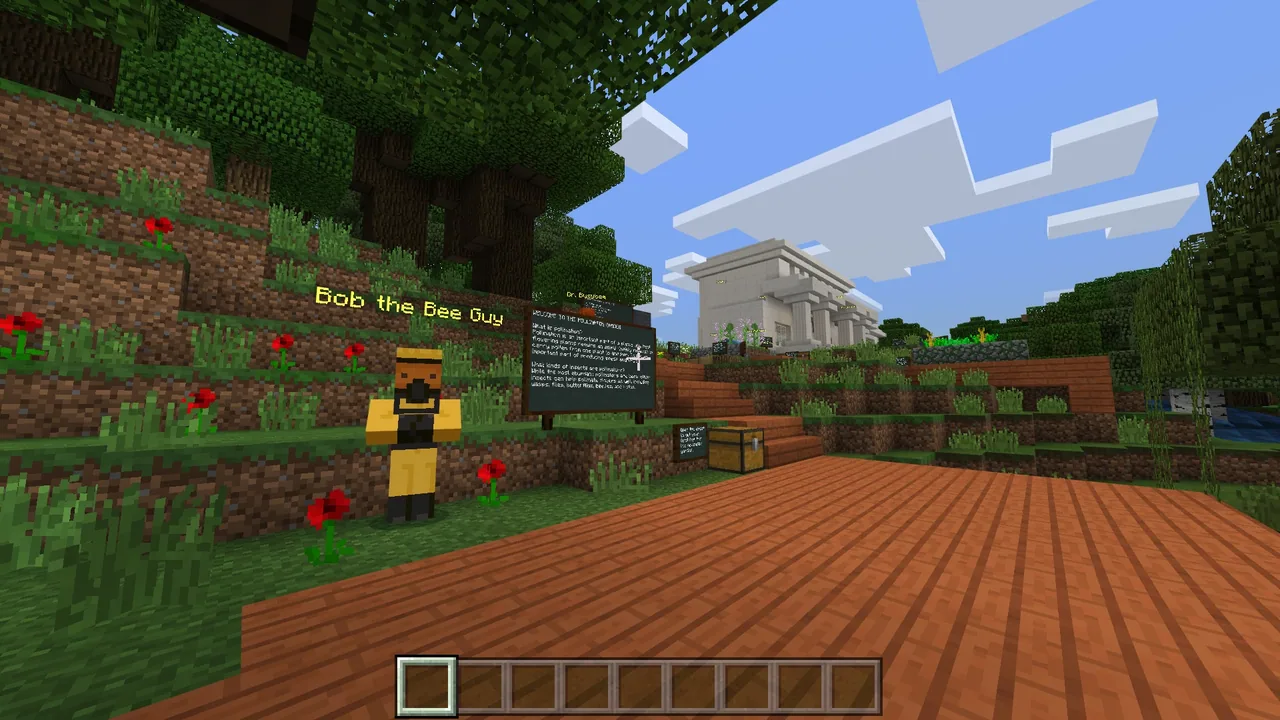
In this lesson, students tour a dedicated Pollinator Garden world in Minecraft Education. Using color-coded research charts, they analyze pollinator preferences, design a 40x20 block plot, gather supplies from an in-game museum, and build a functioning garden with educational signage.
Learning objectives
By the end of this lesson students will be able to:
- Explain the importance of pollinators to ecosystems and the global food supply.
- Select appropriate flower colors and substrates based on pollinator sensory traits and nesting needs.
- Design and construct a structured 40x20 block pollinator garden featuring flora, water, and educational signage.
- Present garden design choices and identify which real-world pollinators the habitat would attract.
Blocks and items used in this lesson


Key vocabulary
- Pollinator
- An animal, such as a bee or butterfly, that transfers pollen between plants to enable reproduction.
- Substrate
- The base surface material, such as dirt, sand, or wood, providing ground structure for living things.
- Pollinator Garden
- A specialized garden planned with specific plants and resources to support threatened pollinating animals.
Before class
Lesson sequence
- Introduction and Discussion
Screen the introductory videos about bees and lead a discussion using guiding questions about what pollinators do, why they are at risk, and how one in three bites of food depends on them.
- Analyzing Information Charts
Distribute the color-coded charts. Review pollinator types on the pink chart, flower colors on the yellow chart (noting bees cannot see red, whereas butterflies and hummingbirds prefer it), and building substrates on the blue chart.
- Layout Planning
Organize students into groups to draft plans on graph paper or through the web-based design tool. Have them map out a 40x20 block plot including paths, water sources, flower beds, and educational signs.
- In-Game Construction
Direct students into the Pollinator Garden world. Students tour the museum, collect designated materials from supply chests, and build out their planned garden plots behind the building.
- Documentation and Presentations
Students capture in-game photographs of their finished plots and educational signs. Each group then presents their work covering their introduction, methods, final results, and anticipated pollinator species.
Assessment: success criteria
- Student explains how pollinator loss impacts food availability and agricultural systems.
- Garden build includes flower colors matched to pollinator vision (e.g., white, yellow, blue, or purple for bees; red for butterflies) alongside varied substrates.
- Minecraft plot integrates required infrastructure, such as water sources, clear walkways, and informational signs.
- Group presentation follows the assigned four-part format (Introduction, Methods, Results, Discussion) using in-game screenshots.
Differentiation
Assign clear group roles and provide checklist templates based on the color-coded charts to guide flower and substrate selection.
Have students research region-specific plants using outside pollinator guides and add educational signs detailing specific ecological threats to local species.
Knowledge check
5 questions to check understanding after the lesson. Tap an answer to see if it is right; the score appears at the end.
1According to the lesson, how much of the food we consume relies on bees for pollination?
Answer: B. The guiding concepts state that one out of every three bites of human food relies on bee pollination.
2Why should a bee-focused garden prioritize white, yellow, blue, or purple flowers over red ones?
Answer: B. The yellow reference chart points out that most bees do not see red and prefer white, yellow, blue, or purple blossoms.
3Which animals mentioned in the lesson are more likely to be attracted to red flowers?
Answer: C. The source notes that hummingbirds and butterflies are more drawn to red blossoms than bees are.
4What are the dimensions of each garden plot available behind the museum?
Answer: D. The activity steps specify that there are four plots available, each measuring 40 by 20 blocks.
5Which set of substrates does the blue chart instruct students to incorporate into their garden designs?
Answer: A. The blue chart explicitly highlights wood, dirt, and sand as essential substrates to make available in the garden.
Resources
Frequently Asked Questions
Where do students obtain their building materials inside the world?
Students can gather all required building items from inside the museum building, along the walking paths, or directly from the storage chests situated beside the garden plots.
Can students plan their gardens digitally before building in Minecraft?
Yes, groups can draft their garden layouts using either physical graph paper or an approved digital garden design tool prior to block placement.
What structure should students follow for their final presentations?
Student presentations must include four defined sections: an Introduction on pollinator value, Methods detailing planning and materials, Results with garden screenshots, and a Discussion on expected visiting pollinators.
Adapted from Building a Pollinator Garden by Kristen Healy on Minecraft Education, last updated Jun 2, 2022. This classroom version, the timings and the quiz were written by 9Minecraft Education.