- Type
- Lesson plan
- Subject
- Math
- Topics
- Math & Economics
- Grade
- Primary (Grades 3-5)
- Ages
- Ages 8-10
- Skills
- Project Based Learning
How can we use mathematical concepts like perimeter, area, arrays, and fractions to accurately plan and model a school garden bed?
Overview
This lesson connects physical measurement in the school environment with mathematical modeling in Minecraft. Students begin by examining an established garden bed outdoors, using real measurement tools to record dimensions and calculate perimeter and fencing requirements on a recording sheet.
Pairs then transition into Minecraft to construct a scaled replica of the garden bed. Using blocks, fencing, and crops, learners calculate area, build visual arrays to solve multiplication and division problems, and partition their garden to model fractions and fraction multiples, documenting all work with signs and the camera.
Learning objectives
By the end of this lesson students will be able to:
- Measure an outdoor garden bed to calculate dimensions and fencing perimeter using appropriate tools.
- Build a scaled digital replica of the garden bed in Minecraft.
- Calculate and record the area of the digital garden bed in square block units.
- Model multiplication and division equations by planting crops in equal arrays.
- Divide the garden bed into equal parts to model unit fractions and fraction multiples.
Blocks and items used in this lesson


Key vocabulary
- Perimeter
- The total distance around the outer boundary of a shape.
- Scale
- A ratio where a unit in a drawing or model represents a specific measurement in real life.
- Area
- The amount of flat surface space enclosed inside a boundary.
- Array
- A set of objects arranged in equal rows and columns to show multiplication or division.
- Fraction
- An equal portion or part of a whole amount.
Before class
Lesson sequence
- Outdoor Garden Measurement
Introduce the project to plan fencing around an established school garden bed. Review the concept of perimeter and discuss appropriate measuring tools such as trundle wheels, tape measures, and rulers. In pairs, students measure the length, width, and fence height requirements of the bed and record their data on the Garden Bed BLM.
- Scaled Construction and Area
Discuss scale representation (for example, one block equals ten centimeters). In the Starter Town world, student pairs build their garden bed and fencing to scale. Students calculate the surface area by counting blocks, place a sign showing length, width, height, perimeter, and area, and document their structure using the Camera and Portfolio.
- Crop Arrays for Multiplication
Review arrays as equal rows and columns used to solve multiplication and division. Assign differentiated problems for pairs to solve by planting crops such as carrots, potatoes, or flowers. Students label each equation and solution on a sign and photograph their work for their Portfolio.
- Partitioning Gardens with Fractions
Review fractions as equal parts of a whole. Pairs divide their garden bed into fractional sections (such as halves, thirds, or quarters) using distinct plant varieties. Introduce fraction multiples, have students replant to demonstrate them, place descriptive signs (such as two thirds carrots and one third wheat), and take portfolio photos.
Assessment: success criteria
- Accurately records length, width, height, and perimeter using the Garden Bed BLM.
- Builds a garden bed and fence in Minecraft matching the specified scale.
- Correctly computes and labels the area of the garden bed using square units.
- Accurately displays multiplication or division solutions using crop arrays.
- Partitions the garden bed to represent assigned fractions and fraction multiples.
Differentiation
Provide pre-determined smaller dimensions or simpler fractions like halves and quarters to guide pairs through basic array and partitioning layouts.
Have students construct an alternative garden bed that retains the exact same perimeter as their first bed but covers a different area.
Knowledge check
5 questions to check understanding after the lesson. Tap an answer to see if it is right; the score appears at the end.
1Which tool from the lesson is suitable for measuring the perimeter of an outdoor garden bed?
Answer: A. Trundle wheels, tape measures, and rulers are the measurement tools specified for recording the garden bed.
2If the scale is set so that 1 block equals 10 cm, how many blocks represent a 50 cm side?
Answer: C. Dividing the 50 cm measurement by 10 cm per block gives a length of 5 Minecraft blocks.
3How do students determine the area of their garden bed inside Minecraft?
Answer: B. Students find area by counting the total number of blocks covering the flat garden space.
4How do students model multiplication problems such as 3 times 5 in their garden beds?
Answer: D. Multiplication is demonstrated by planting crops in structured arrays of equal rows and columns.
5Which in-game tools are used to record and store student measurements and math work?
Answer: A. Students place signs with equations and measurements in front of their beds and capture photos using the Camera and Portfolio.
Resources
- Lesson package (.zip)Everything the author attached to this lesson in one download.
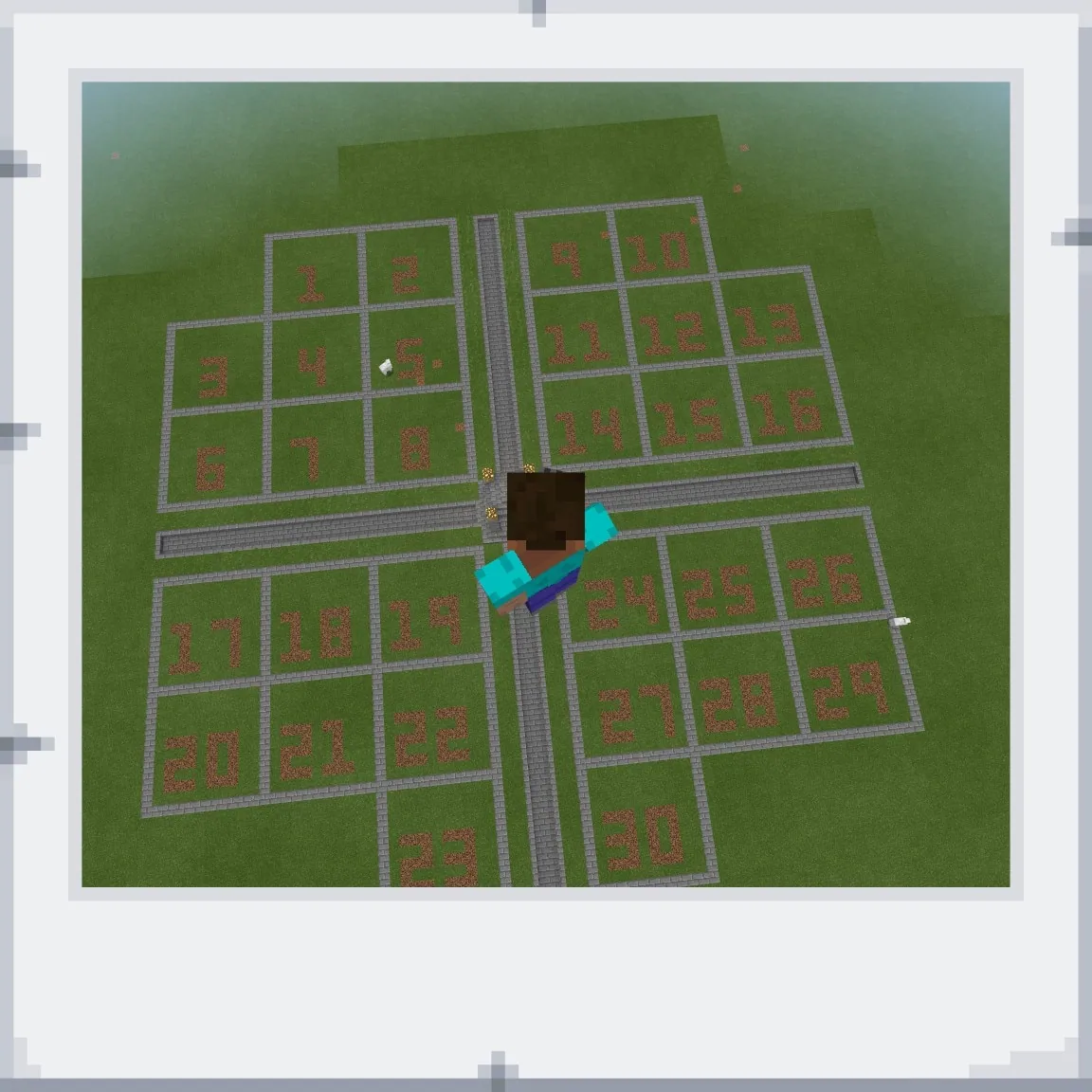
- Starter TownThis town has a set of thirty, 10x10 bordered plots for students to create their garden bed.
- Garden Bed BLMTemplate of a Grid and Table for students to record their information
Frequently Asked Questions
Which Minecraft world is used for this activity?
The lesson uses the downloadable Starter Town world listed in the supporting files.
How do students document their calculations inside the game?
Students place signs in front of their garden beds displaying their measurements, equations, and answers, then capture photos using the in-game Camera and Portfolio.
How can teachers adapt the array and fraction tasks for different abilities?
Teachers can provide differentiated multiplication facts for the crop arrays and assign varying fractions, ranging from simple unit fractions like halves to fraction multiples like two-thirds.
Adapted from Building a Garden Bed by Nicola Rusten on Minecraft Education, last updated Mar 4, 2025. This classroom version, the timings and the quiz were written by 9Minecraft Education.