- Type
- Lesson plan
- Topics
- ScienceClimate Science
- Ages
- Ages 6-13
- Includes
- Quiz: 5 questionsLesson files
How do individual bees work together as a collective mind to build, maintain, and protect a thriving colony?
Overview
In this collaborative science lesson, students explore the complex social structure and shared intelligence of a bee colony by stepping directly into the role of bees. Through guided inquiry, learners investigate how individual colony members communicate, divide labor, gather resources, and safeguard their queen and brood without a central boss giving constant spoken orders.
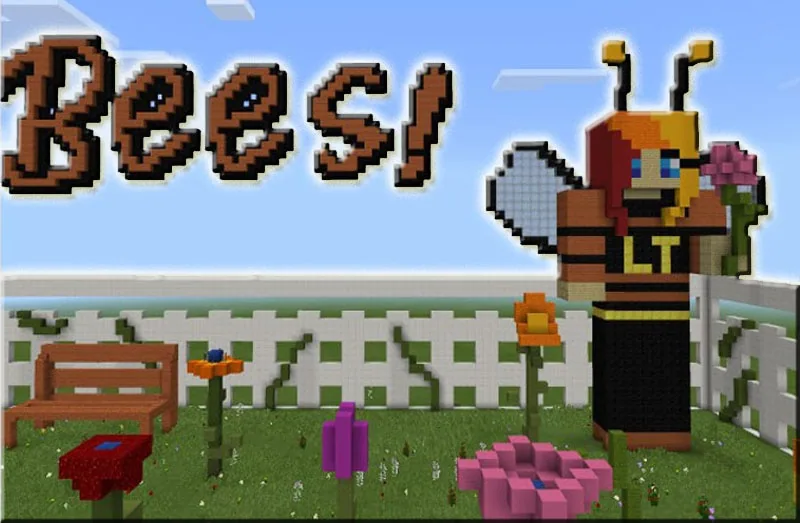
Inside Minecraft, students put on custom bee skins and work together in a shared world to harvest glowstone pollen from flowers and construct a complete beehive. As they build chambers for food, eggs, and defense, students simulate non-verbal insect communication, document their work with camera portfolios, and reflect on how collective decision-making compares to human society.
Learning objectives
By the end of this lesson students will be able to:
- Identify key roles within a colony and explain how specialized labor keeps the hive alive.
- Simulate non-verbal bee communication while collaborating with peers to complete a shared project.
- Design and construct a multi-chambered beehive in Minecraft that includes areas for food storage, brood care, and hive defense.
- Compare the collective decision-making of social insects to human community rules and cooperation.
Blocks and items used in this lesson
 Glowstone Dust
 Chalkboard
 Camera
 Book
Key vocabulary
- Super Mind
- A collective intelligence where many separate individuals act together as a single unified system.
- Pollen
- A fine powder produced by flowers, represented in this Minecraft world by glowstone dust.
- Chamber
- An individual compartment or hexagonal cell inside a beehive used for eggs, honey, or larvae.
- Forager
- A worker bee whose primary job is to fly outside the hive to find and collect pollen and nectar.
Before class
Lesson sequence
- Inquiry and Colony Decision-Making
Introduce the challenge by explaining that students are now bees needing a new hive. Lead a discussion on bee species and have the class decide which species they will represent. Discuss decision-making methods to introduce the concept of a hive mind, and review how bees communicate locations without spoken language.
- Role Selection and World Entry
Have students install their bee skins and join the host world. Assign hive duties, such as worker bees, foragers, and reporter bees who will document the simulation. Remind students that no player may take the role of the queen.
- Resource Gathering and Simulation
Students enter the garden to harvest glowstone dust from flower tops to represent pollen collection. Encourage students to communicate silently or through movement rather than talking as they act out hive duties, including cooling the hive, protecting resources, and nurturing the brood.
- Collaborative Hive Construction
The whole class works together to build the physical nest. Use periodic pauses to prompt students to check their progress: identify who is producing honey, where pollen is stored, where larvae are protected, and where dead bees are placed. Reporter bees capture key moments using portfolio photos or video.
- Labeling and Reflection
Students place posters on the exterior and interior of the hive to label every chamber and summarize colony roles. Gather the class for a group photo in front of the completed structure, then reflect on how the collective mind operated and how human communities establish rules.
Assessment: success criteria
- Student accurately explains their assigned colony role and how it supports the survival of the hive.
- Student collaborates effectively with peers to build a hive containing distinct, functional chambers.
- Student creates portfolio documentation or poster labels identifying the purpose of specific hive sections.
- Student participates in discussions comparing insect super minds to human decision-making and societal rules.
Differentiation
Assign struggling students to partner with a peer as paired foragers or hive builders, providing clear visual diagrams of hexagonal honeycomb cells.
Have advanced students serve as lead colony reporters who document complex behaviors such as hive cooling, defensive formations, and route signaling in detailed portfolio captions.
Knowledge check
5 questions to check understanding after the lesson. Tap an answer to see if it is right; the score appears at the end.
1What Minecraft material is used to represent pollen on top of flowers in this lesson?
Answer: B. The lesson source states that the world has flowers topped with glowstone dust representing pollen.
2Which role is specifically unavailable for students to play during the simulation?
Answer: C. The lesson notes that students cannot be the queen because standing around laying eggs is not suitable for this student role-play.
3What primary responsibility do Reporter Bees have during the hive project?
Answer: D. Reporter bees are tasked with capturing screenshots, photos, and video to record colony activities for assessment portfolios.
4What communication challenge are students asked to explore while building the nest?
Answer: A. The lesson asks how bees manage complex tasks without talking and suggests trying not to talk while constructing the hive.
5How do students explain the purpose of the finished chambers at the end of the build?
Answer: A. The source specifies that students make posters on the side of the nest to label chambers and include information about bee roles.
Resources
Frequently Asked Questions
How do students install the bee skins before joining the world?
Provide students with the custom bee skins file. When students double-click the file, Minecraft Education launches automatically, allowing each student to choose one of three available bee skins.
What should I do if students start talking constantly during the build phase?
Use the pause feature or call a quick timeout to remind learners of the guiding question regarding non-verbal communication. Encourage them to use avatar movements, positioning, and in-game signaling to experience how a hive mind coordinates without spoken language.
How can I assess student learning at the end of the project?
Review the informational posters students place around the hive, inspect the exported photo portfolios created by reporter bees, and evaluate student contributions during the concluding discussion on collective intelligence.
Adapted from Bees! Bees! Bees! Be a Bee! by Lynne Telfer on Minecraft Education, last updated Dec 8, 2018. This classroom version, the timings and the quiz were written by 9Minecraft Education.