- Type
- Lesson plan
- Ages
- Ages 6-10
- Skills
- CollaborationCreativity
How can exploring a virtual world and building models help us solve and create addition problems?
Overview
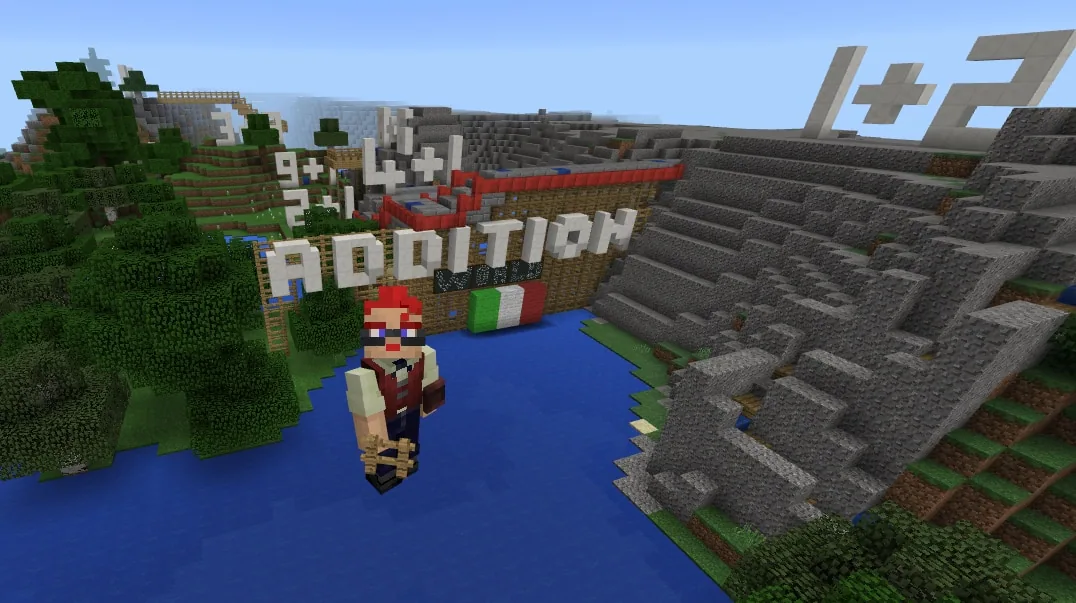
Addition World guides learners through foundational addition practice by combining digital navigation with traditional pencil-and-paper recordkeeping. As students travel through three distinct zones, they practice calculating sums, verifying equations, and formulating their own mathematical questions.
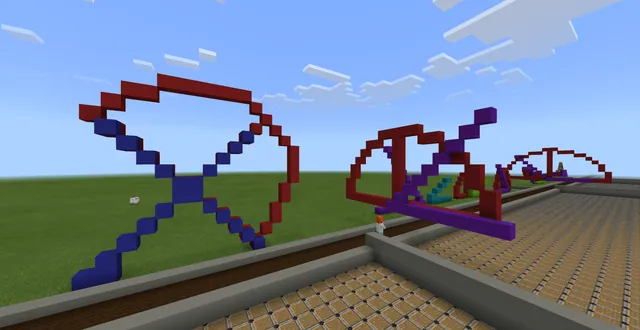
Within the pre-built world, learners follow color-coded pathways that lead to different task stations. In early zones, students locate addition prompts along a blue path and build sums in designated allow block zones along a yellow path, before crossing a bridge to construct custom math challenges for their peers.
Learning objectives
By the end of this lesson students will be able to:
- Record the correct solutions to in-game addition problems using pencil and paper.
- Construct block representations of addition solutions inside designated allow block areas.
- Design original addition problems in Minecraft to challenge classmates.
- Navigate along colored paths collaboratively while remaining focused on lesson objectives.
Blocks and items used in this lesson


Key vocabulary
- Addition
- The mathematical process of combining two or more numbers to find a total sum.
- Allow Block
- A special Minecraft block that permits players to place or break blocks within its boundary.
- Slate
- A small in-game chalkboard used to display written text or mathematical problems.
Before class
Lesson sequence
- Zone 1: Blue Path Exploration
Students enter Addition World and follow the blue path through the first zone. As they discover addition problems placed throughout the landscape, they calculate each sum and record their answers on paper using a pencil.
- Zone 2: Stables and Yellow Path Building
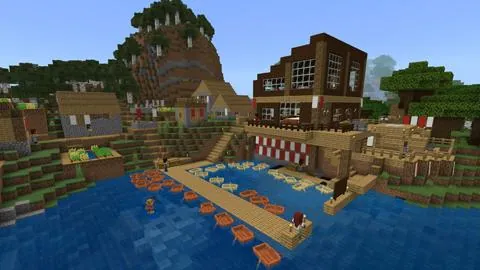
Learners leave their horses in the stable and switch to the yellow path. This route directs them to allow block areas where they read additions on slates, build the resulting sums using blocks, and log the verified answers on their sheets.
- Zone 3: Remote Village and Challenge Bridge
Students cross a long bridge from a remote village into a large allow block zone. In this collaborative area, learners construct their own addition problems using blocks and invite peers to solve them.
Assessment: success criteria
- Student paper sheets contain accurate sums for all discovered addition prompts.
- Block builds in the second zone accurately represent the values required by the slate problems.
- Learners construct solvable, original addition equations in the final zone.
- Students demonstrate collaboration and stay on designated paths without drifting off-task.
Differentiation
Allow learners to work in pairs and use in-game blocks as physical counters to calculate sums step by step.
Have students modify the world in single-player mode by editing the slates with new addition equations for a peer to play and solve.
Knowledge check
5 questions to check understanding after the lesson. Tap an answer to see if it is right; the score appears at the end.
1Which colored path do students follow in the very first zone?
Answer: B. The lesson plan states that students follow a blue path in the first zone to discover additions.
2Where do students leave their horses before starting the second zone?
Answer: A. The source specifies that kids leave their horses in the stable right before following the yellow path.
3How are students instructed to record their answers while discovering additions?
Answer: C. Students are instructed to use a pencil and blank paper to write down the results of the additions they find.
4What structure conducts students from the remote village to the third zone's allow block area?
Answer: D. The source notes that a very long bridge conducts students from the remote village to the final allow block area.
5What do students create in the final allow block area?
Answer: A. In the third zone, students use the allow block area to build their own additions and challenge peers to solve them.
Resources
- Lesson package (.zip)Everything the author attached to this lesson in one download.
- The Addition SheetThe file of the Addition Sheet
- The Addition PortfolioThe file of the Addition Portfolio
Frequently Asked Questions
What physical materials do students need during this digital lesson?
Students need pencils, blank paper, and the lesson's supporting files, which include The Addition Sheet and The Addition Portfolio.
Can this lesson be adapted for single-player use?
Yes. Students can explore individually and modify the slate additions in the world, then swap worlds with a peer to solve each other's custom equations.
Why are allow blocks used in the second and third zones?
Allow blocks define designated zones where students have permission to place and arrange blocks to display their answers and build custom math challenges.
Adapted from Addition World by Marco Vigelini on Minecraft Education, last updated Jun 28, 2022. This classroom version, the timings and the quiz were written by 9Minecraft Education.