- Type
- Lesson plan
- Ages
- Ages 6-13
- Duration
- 2 hours
- Level
- Beginner
How can sustainable urban design and engineering choices reduce the Urban Heat Island effect to make cities cooler and more livable?
Overview
The Urban Heat Island (UHI) effect causes cities to experience significantly higher temperatures than neighboring rural regions due to dense buildings, dark pavement, and a scarcity of green spaces. Rising urban temperatures strain electrical grids, increase air conditioning demand, and threaten human health—especially vulnerable populations like children and the elderly.
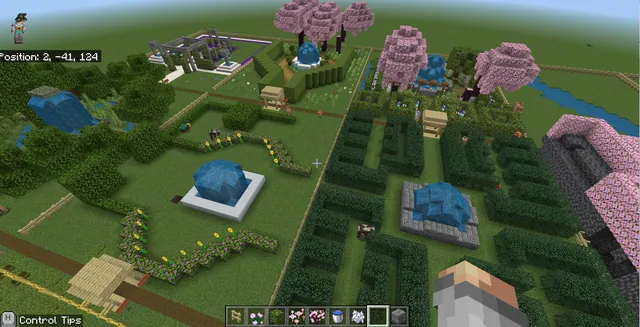
In this project-based lesson, students enter the coastal city of Oasis Harbor to act as sustainability coordinators aligned with UN Sustainable Development Goal 11. By consulting local non-player characters and redesigning the built environment with green roofs, reflective surfaces, shade structures, and pocket parks, learners discover how strategic urban planning mitigates extreme heat.
Learning objectives
By the end of this lesson students will be able to:
- Explain the causes of the Urban Heat Island effect and its impacts on human health and energy use.
- Identify diverse urban cooling tactics such as green roofs, reflective surfaces, and park networks.
- Design and build sustainable urban infrastructure changes in Oasis Harbor to lower city temperatures.
- Document architectural modifications and reflect on their cooling benefits using the in-game camera and portfolio.
Blocks and items used in this lesson


Key vocabulary
- Urban Heat Island (UHI) Effect
- A condition where urban areas experience much higher temperatures than surrounding rural lands due to dense construction and paved surfaces.
- Albedo
- The ability of a surface to reflect sunlight rather than absorbing it as heat.
- Mitigation
- Actions or design strategies intended to reduce the severity or harmful impact of an environmental problem.
- Sustainable Development Goal 11
- A United Nations target focused on making human settlements and cities inclusive, safe, resilient, and sustainable.
Before class
Lesson sequence
Suggested timing: about 120 minutes in total.
- Research and City Exploration25 min
Introduce the Urban Heat Island effect and review its impact on public health and city temperatures. Students spawn into Oasis Harbor to examine the existing layout and talk with local NPCs to gather guidance on heat mitigation tactics.
- Target Area Selection and Planning20 min
Working either independently or in teams, students survey the city to identify heat-trapping zones. They select specific sites for redevelopment and draft a plan prioritizing interventions like pocket parks, reflective pavement, or water features.
- Sustainable Design and Construction45 min
Students roll up their sleeves as urban planners, constructing features to cool Oasis Harbor. They implement targeted solutions such as:
- Installing green roofs and tree-lined streets to provide shade and insulation.
- Replacing dark ground materials with light-colored, high-albedo cool pavements.
- Adding pocket parks, windbreaks, cooling towers, and water features.
- Documentation and Journaling15 min
Throughout the build, learners capture their interventions using the camera and portfolio. They write journal entries in the book and quill explaining why they chose specific materials and how those changes lower local temperatures.
- Class Presentation and Peer Feedback15 min
Students present their completed urban modifications to classmates by sharing screenshots or giving guided walkthroughs. The class discusses the merits of each cooling strategy and offers constructive peer feedback.
Assessment: success criteria
- Student clearly explains the causes and consequences of the Urban Heat Island effect during discussions or journal entries.
- Constructed builds in Oasis Harbor incorporate identifiable cooling features such as vegetation, reflective surfaces, shade, or water bodies.
- Student journal or portfolio documents the rationale behind each architectural intervention.
- Student actively presents their urban design solutions and participates in peer evaluations.
Differentiation
Provide a targeted checklist of straightforward cooling tactics, such as replacing dark asphalt with light blocks or lining streets with shade trees.
Challenge students to re-engineer multi-block districts combining complex systems like cooling towers, windbreaks, and shaded solar installations.
Knowledge check
5 questions to check understanding after the lesson. Tap an answer to see if it is right; the score appears at the end.
1What is the primary cause of the Urban Heat Island effect described in the lesson?
Answer: A. Urban heat islands form when high building density and extensive pavement absorb heat while lacking sufficient green space.
2Which United Nations Sustainable Development Goal guides the mission in Oasis Harbor?
Answer: C. Goal 11 focuses directly on creating safe, sustainable, and resilient urban settlements.
3How does increasing a surface's albedo help lower urban temperatures?
Answer: B. High-albedo materials are lighter in color, reflecting solar energy back into the atmosphere instead of soaking it up as heat.
4Which in-game tools are specifically used by students to record and reflect upon their builds?
Answer: D. Students document visual progress with the camera and portfolio and write reflections in the book and quill.
5Which of the following interventions is suggested as a way to introduce natural cooling in Oasis Harbor?
Answer: B. Green roofs incorporate vegetation and soil that absorb solar energy and provide cooling insulation for buildings.
Resources
- Lesson package (.zip)Everything the author attached to this lesson in one download.
- Next Gen Science Standard ConnectionsNGSS Connections
- ISTE Student Standards ConnectionsISTE Connections
- Global Competencies ConnectionsGlobal Competencies
- 20 Teacher Question PromptsIf a student is stuck or feels they are done early.
- Extension ActivitiesExtensions beyond Minecraft
- UHI Intro PresentationBrief intro to UHI
- Sun Blocks Title ImageTitle Image
Frequently Asked Questions
Can students work collaboratively on this urban planning task?
Yes. The lesson is designed to support both individual designers and collaborative student teams working together to redevelop neighborhoods in Oasis Harbor.
What role do non-player characters (NPCs) play in the lesson?
NPCs stationed throughout Oasis Harbor act as advisors from the Urban Planning Team, providing students with guidance and background information on specific heat mitigation tactics.
What age group is this lesson plan appropriate for?
The lesson covers beginner-level concepts and includes activities adaptable for primary through lower secondary students aged 6 through 13.
Adapted from Sun Blocks - Crafting Cooler Cities by Logics Academy on Minecraft Education, last updated Jul 11, 2024. This classroom version, the timings and the quiz were written by 9Minecraft Education.