- Type
- Lesson plan
- Ages
- Ages 11-18
- Duration
- 2 hours
- Level
- Intermediate
How can identifying hazards and listening to workers help us design safer and more productive work environments?
Overview
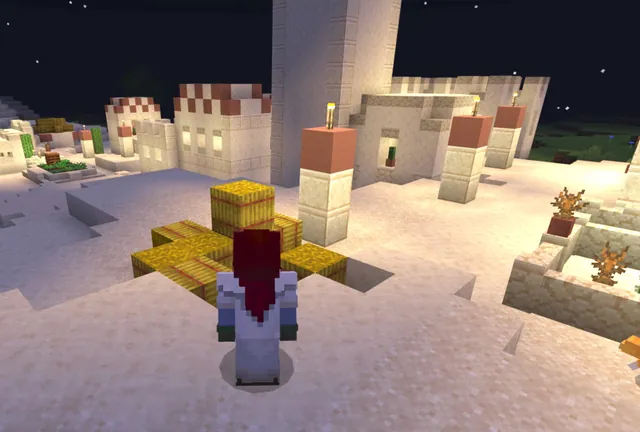
Workplace health and safety is an essential life skill for secondary students entering the workforce. In this lesson, students explore the historic ShelfLife Mill in Bookmark Bay, stepping into the role of safety consultants called in by Reginald Shelfman II after conditions deteriorated under his son Reggie's management.
Using Minecraft Education as a real-time risk simulation, learners speak with non-player characters to uncover safety grievances, conduct an inspection of the mill to log physical risks, rebuild hazardous areas using practical safeguards, and compile their findings into an evaluative safety audit.
Learning objectives
By the end of this lesson students will be able to:
- Listen actively to employee concerns by recording details gathered from non-player characters across the mill.
- Document physical hazards such as blocked exits, missing safety gear, and slippery walkways using in-game journals or signs.
- Mitigate workplace hazards by building physical interventions like guardrails, improved lighting, clear pathways, and warning signs.
- Evaluate safety performance by scoring mill conditions before and after hazard remediation.
- Produce a structured final safety report summarizing hazards found, actions taken, and recommendations.
Blocks and items used in this lesson


Key vocabulary
- Hazard
- Any source of potential damage, harm, or adverse health effects on something or someone at work.
- Mitigation
- The action of reducing the severity, seriousness, or likelihood of a hazard causing harm.
- Personal Protective Equipment (PPE)
- Gear worn by workers to minimize exposure to hazards that cause serious workplace injuries and illnesses.
- Risk Assessment
- A systematic process of identifying potential hazards and analyzing what could happen if a hazard occurs.
Before class
Lesson sequence
Suggested timing: about 120 minutes in total.
- Briefing and Mill Orientation15 min
Introduce the scenario: Reginald Shelfman II has asked students to audit ShelfLife Mill after safety standards dropped under his son Reggie. Review the concept of workplace safety as a shared responsibility and connect the mission to global targets for safe working environments.
- Worker Interviews and Hazard Hunt35 min
Direct students to enter the mill, interact with NPC workers, and listen carefully to their daily safety concerns. Students explore each zone on a scavenger hunt to discover hazards such as poor lighting, obstructed emergency exits, slippery floors, and missing protective gear, logging their observations on signs or in an in-game journal.
- Hazard Mitigation and Engineering Solutions40 min
Students use building tools to correct the safety issues they cataloged. Interventions include installing safety railings, establishing unobstructed walkways, setting up clear signage, improving lighting in dark spaces, and providing proper storage for equipment.
- Safety Evaluation and Reporting30 min
Learners assess the mill's safety by assigning a comparative score before and after their changes. Students compile their interview notes, photos, and mitigation strategies into a final presentation or written report to justify their safety recommendations to the mill owners.
Assessment: success criteria
- The student records accurate details and grievances collected from interviews with mill workers.
- The student documents multiple distinct hazards across different zones of the mill using structured notes.
- The student constructs sensible, realistic safety interventions such as handrails, clear paths, and signage.
- The student compiles a complete final safety report that includes pre- and post-intervention evaluations.
Differentiation
Provide a guided inspection checklist listing specific mill zones so learners know exactly what hazards to watch for.
Ask learners to calculate a detailed safety score out of 10 and include formal policy recommendations for Reggie Shelfman in their final report.
Knowledge check
5 questions to check understanding after the lesson. Tap an answer to see if it is right; the score appears at the end.
1Why has Reginald Shelfman II requested help at ShelfLife Mill?
Answer: B. Reginald Shelfman II asks for help because safety standards slipped and accidents started piling up after his son Reggie took over.
2What is the primary purpose of conducting interviews with NPC workers in the mill?
Answer: B. Interviews require students to listen actively and note safety issues directly described by the workers.
3Which of the following is an example of an environmental hazard students might find in the mill?
Answer: C. The scavenger hunt tasks students with identifying hazards like slippery floors, missing PPE, fire risks, and blocked exits.
4How do students mitigate the safety risks they discover during their inspection?
Answer: C. Hazard mitigation involves fixing areas by adding railings, clear walkways, improved lighting, and safety signage.
5What should students include in their final safety assessment?
Answer: B. Students compile a report summarizing findings, mitigation efforts, and safety scores comparing conditions before and after their work.
Resources
- Lesson package (.zip)Everything the author attached to this lesson in one download.
- Educator Support QuestionsSupportive questions for students who excel or get stuck
- Common Core Curriculum ConnectionsCommon Core Curriculum Connections
- ISTE Student Standards ConnectionsISTE Student Standards Connections
- Next Gen Science Standards ConnectionsNext Gen Science Standards Connections
- Canadian Curriculum ConnectionsCanadian Curriculum Connections
- Global Programs ConnectionsGlobal Programs Connections
Frequently Asked Questions
What age group is this safety lesson suited for?
This lesson is designed for students in grades 7 through 12 (ages 11 to 18), providing relevant career and workplace wellness education before they enter part-time or full-time employment.
How can students document their evidence inside the Minecraft world?
Students can place in-game signs next to hazards or use the in-game camera and portfolio tools to snap photographs and record observations for their final report.
Can this lesson be split across multiple class periods?
Yes. The two-hour duration easily divides into two 60-minute sessions, with the first session dedicated to worker interviews and hazard hunting, and the second focused on building mitigations and preparing the report.
Adapted from Smart Shift - Work Safe by Logics Academy on Minecraft Education, last updated May 29, 2025. This classroom version, the timings and the quiz were written by 9Minecraft Education.