- Type
- Lesson plan
- Ages
- Ages 8-13
- Includes
- Quiz: 5 questions
How can an underutilised school space be redesigned into an accessible sensory garden that supports user well-being and native plant life?
Overview
Outdoor learning environments enhance student well-being by creating direct contact with the natural world. In this project-based unit, students assess an underutilised space on their school campus and reimagine it as a sensory garden designed to stimulate sight, sound, touch, taste, and smell. Along the way, they investigate native plant adaptations, consider the requirements of different garden users, and draft grant requests to fund their ideas.
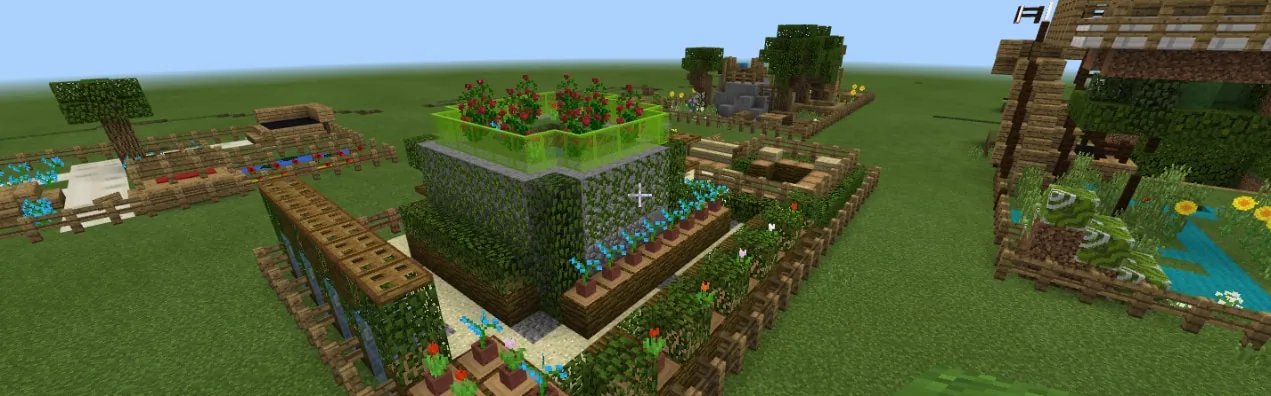
Minecraft Education serves as the digital prototyping tool where students apply mathematical concepts of length, area, and scale. After recording real-world measurements of their chosen site, student teams recreate existing ground features in-game and build proposed garden designs that satisfy safety constraints, budget limitations, and environmental sustainability goals.
Learning objectives
By the end of this lesson students will be able to:
- Explain how social needs and environmental factors shape the design of outdoor spaces.
- Investigate local plant adaptations to select appropriate flora for a school garden.
- Apply units of measurement to record real-world site dimensions and translate them to scale in Minecraft.
- Collaborate in teams to construct a garden prototype that meets agreed success criteria and safety needs.
- Estimate material expenses using online or store research to create a realistic project budget.
Blocks and items used in this lesson


Key vocabulary
- Sensory Garden
- An outdoor space designed intentionally to stimulate the senses of sight, smell, touch, taste, and hearing.
- Adaptation
- A physical structure or characteristic that helps a living thing survive in its local environment.
- Scale
- The proportional ratio used to represent real-world measurements accurately in a smaller model.
- Design Brief
- A written project guide detailing the requirements, user needs, and boundaries of a design challenge.
Before class
Lesson sequence
- Discovering Sensory Spaces
Introduce the purpose of sensory gardens and nature play environments. Have students visit a local community garden or examine existing outdoor spaces to analyze how specific design elements activate sight, smell, touch, sound, and taste.
- Design Brief and Grant Writing
Present the design brief to improve a neglected school space. Students discuss stakeholder needs and compose persuasive letters to the school principal, parent committees, or local councils to request project funding.
- Site Survey and Plant Research
Take students outside to measure the project site boundaries and record existing physical features. In the classroom, students investigate native plant adaptations to identify species suited to local climate and soil conditions.
- Minecraft Prototyping
Establish shared design criteria covering safety, user needs, maintenance, and sustainability. Working in project teams, students build their real-world space to scale in Minecraft and construct their proposed sensory garden layouts.
- Peer Evaluation and Costing
Teams present their digital builds and evaluate peer projects against the agreed success criteria. Students then research real-world material and plant prices online or through hardware stores to construct a final budget proposal.
Assessment: success criteria
- Garden model accurately reflects real-world site measurements and spatial scale.
- Selected plants and features demonstrate understanding of local environmental adaptations.
- Design includes sensory stimulation zones alongside quiet relaxation areas.
- Peer review and budget proposal adhere to the established project success criteria.
Differentiation
Provide pre-scaled grid templates and a focused checklist of required sensory zones to assist with spatial planning.
Have students consult with school safety guidelines or local contractors to verify that their proposals meet building and departmental codes.
Knowledge check
5 questions to check understanding after the lesson. Tap an answer to see if it is right; the score appears at the end.
1What is the primary objective of a sensory garden?
Answer: A. A sensory garden is specifically planned to engage and stimulate all five senses through varied natural elements.
2Why do students examine plant adaptations during the planning phase?
Answer: B. Researching adaptations helps students choose plants that are well-suited to the local environment and climate.
3How do students apply mathematics when preparing their Minecraft build?
Answer: C. Students measure the real outdoor space and use those numbers to accurately recreate the site to scale in Minecraft.
4Which audience might students write persuasive letters to for project grants?
Answer: B. The design process includes writing persuasive funding proposals to school leaders, parent groups, or local government bodies.
5Which feature is listed as part of the garden design success criteria?
Answer: D. The assessment criteria emphasize low-maintenance planning, environmental sustainability, and departmental safety standards.
Frequently Asked Questions
Does this lesson require a pre-built custom world download?
No special world download is required. Students map their own school's actual grounds and recreate the dimensions directly inside a standard open Minecraft world.
How do students determine the project budget?
Students research pricing for their selected plants, soil, and building materials by checking online retailers or consulting local hardware store listings.
Adapted from Sensory Garden Project by Zoe Lee on Minecraft Education, last updated Jul 13, 2018. This classroom version, the timings and the quiz were written by 9Minecraft Education.