How do museum exhibits use space, scale, and design to spark curiosity about science?
Overview
Science centers rely on deliberate spatial design, varied scales, and multi-sensory presentations to spark curiosity and communicate complex STEM concepts to the public. By investigating how museum spaces connect different fields of science and engineering, students learn how physical environments can facilitate informal learning and public engagement.
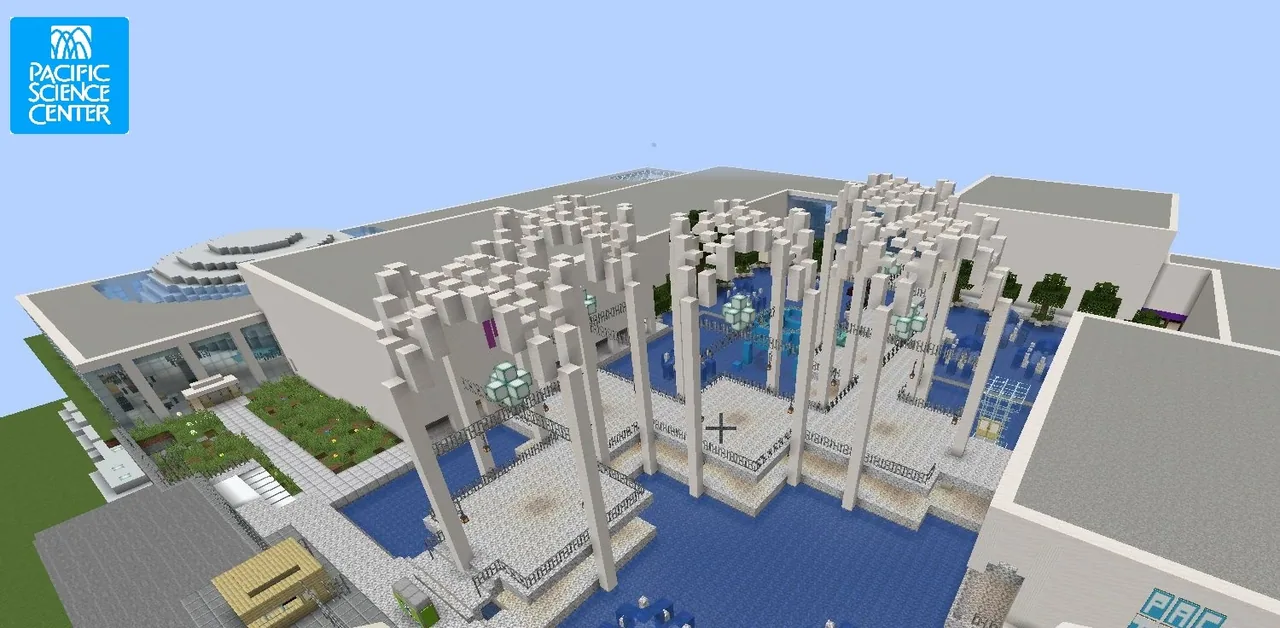
In this lesson, students tour a digital scale model of the Pacific Science Center campus, observing galleries that cover topics such as astronomy, living creatures, human health, and physics. Learners then enter Building 4, an open gallery supplied with materials in chests, where they design and construct their own science exhibits either individually or as a collaborative team.
Learning objectives
By the end of this lesson students will be able to:
- Explore how museum layouts and scale encourage curiosity about STEM topics.
- Analyze how colors, text, materials, and media combine to communicate scientific ideas.
- Design and construct an original STEM exhibit inside the museum's empty gallery.
- Discuss effective science communication strategies and how they can be applied to community spaces.
Blocks and items used in this lesson


Key vocabulary
- Exhibit
- A curated public display of objects, media, or interactive models designed to teach a specific concept.
- Scale
- The relative size or proportion of a model compared to the actual object it represents.
- Interactive
- A display or device that invites visitors to physically participate, manipulate parts, or run tests.
Before class
Lesson sequence
Suggested timing: about 60 minutes in total.
- Introduction5 min
Welcome students to the scale model of the Pacific Science Center. Explain that as they tour the campus, they should pay attention to how exhibits use space, color, text, and scale to make science engaging and prompt questions.
- Museum Exploration20 min
Have students explore the museum galleries, courtyard, theaters, and behind-the-scenes areas independently or in guided groups. Ask them to take notes on displays covering astronomy, dinosaurs, butterflies, naked mole rats, human health, music, and physics, observing which design choices capture their interest.
- Exhibit Design in Building 425 min
Direct learners to Building 4, an empty exhibit hall stocked with supplies in chests. Students work individually or in teams to design and build an original exhibit on a STEM topic related to their class curriculum, applying communication techniques they observed during the tour.
- Review and Discussion10 min
Gather the class to tour student creations in Building 4. Lead a discussion on what forms of science communication were most effective, how their builds encourage curiosity, and how exhibits can represent scientific connections.
Assessment: success criteria
- Student identifies how museum galleries use materials, color, and scale to engage visitors.
- Student constructs a themed STEM exhibit using the supplies provided in Building 4.
- Student explains how their custom exhibit communicates scientific or engineering concepts to an audience.
Differentiation
Allow students to work in small groups with assigned roles to construct a shared exhibit in Building 4.
Challenge students to incorporate multiple communication methods, such as signs, scale models, and interactive elements, within their exhibit.
Knowledge check
5 questions to check understanding after the lesson. Tap an answer to see if it is right; the score appears at the end.
1Which location on the campus provides an empty space for students to build their own exhibit?
Answer: D. Building 4 is designated in the lesson as the empty exhibit hall where students construct their displays.
2Where do students find the building materials needed to create their custom exhibits?
Answer: A. The lesson states that supplies are provided in chests inside the empty building for students to use.
3Which of the following topics is specifically mentioned as an exhibit area in the virtual museum?
Answer: B. The source lists naked mole rats alongside butterflies, dinosaurs, astronomy, health, music, and physics as exhibit content.
4What are students asked to observe while touring the different museum spaces?
Answer: B. The lesson guides students to observe how design elements like colors, text, images, and materials support the science content and inspire curiosity.
5In which city is the real-world landmark that this Minecraft world models?
Answer: C. The introduction identifies the build as a scale model of Seattle's iconic science museum.
Frequently Asked Questions
Can students work collaboratively on their final exhibit?
Yes. Students can create individual displays or work together as a class, with each student taking responsibility for a specific portion of the build in Building 4.
What science topics does the virtual campus cover?
The campus includes exhibits on astronomy, dinosaurs, butterflies, naked mole rats, human health, music, and basic physics, giving teachers flexibility to link the tour to multiple curriculum areas.
Adapted from Pacific Science Center by Pacific Science Center on Minecraft Education, last updated Jul 14, 2022. This classroom version, the timings and the quiz were written by 9Minecraft Education.