- Type
- Lesson plan
- Subject
- Math
- Topics
- Math & Economics
- Ages
- Ages 6-10
How do repeated addition and fair sharing help us understand multiplication and division?
Overview
Students investigate basic multiplication and division by connecting arithmetic operations to visual and auditory cues. By treating multiplication as repeated addition and division as fair sharing between equal groups, learners build conceptual foundations for early math. The lesson also highlights the concept of equality, showing that the physical arrangement of objects does not change their total count.In the downloadable Minecraft world, learners navigate through numbered classrooms set to Adventure mode. They flip levers linked to redstone lamps and note blocks to observe equations in light and pitch, interact with non-player characters to answer multiple-choice questions, and distribute redstone lamps evenly between pairs of characters to demonstrate equal grouping.
Learning objectives
By the end of this lesson students will be able to:
- Solve basic multiplication equations from 1 x 1 through 1 x 10 using visual and audio feedback.
- Demonstrate fair sharing by distributing redstone lamps equally between pairs of characters.
- Explain that a set of objects remains equal in total quantity regardless of its spatial arrangement.
Blocks and items used in this lesson


Key vocabulary
- Repeated Addition
- Adding the same number multiple times to find a product, such as 1 + 1 + 1 = 3.
- Fair Sharing
- Dividing a collection of items equally so that every recipient gets the exact same amount.
- Equal To
- Having the same total value or quantity, even if items are arranged in different formations.
Before class
Lesson sequence
- Audio-Visual Multiplication Introduction
Introduce multiplication as repeated addition before entering Classroom One. Students pull levers corresponding to equations from 1 x 1 to 1 x 10, observing simultaneous light from redstone lamps and tone pitches from note blocks.
- Review and Formative Checks
Students move through Classrooms Two and Three to review equations from 1 x 1 to 1 x 5 and 1 x 6 to 1 x 10. They interact with NPCs to answer multiple-choice questions, reading feedback on the heads-up display and placing lamps from chests into designated spots if they need counting assistance.
- Exploring Conservation of Number
In Classroom Four, learners study wall displays showing groups of 1 to 6 objects arranged in various patterns. The teacher leads a brief discussion explaining that rearranging the formation of a group does not alter its total quantity.
- Fair Sharing Division
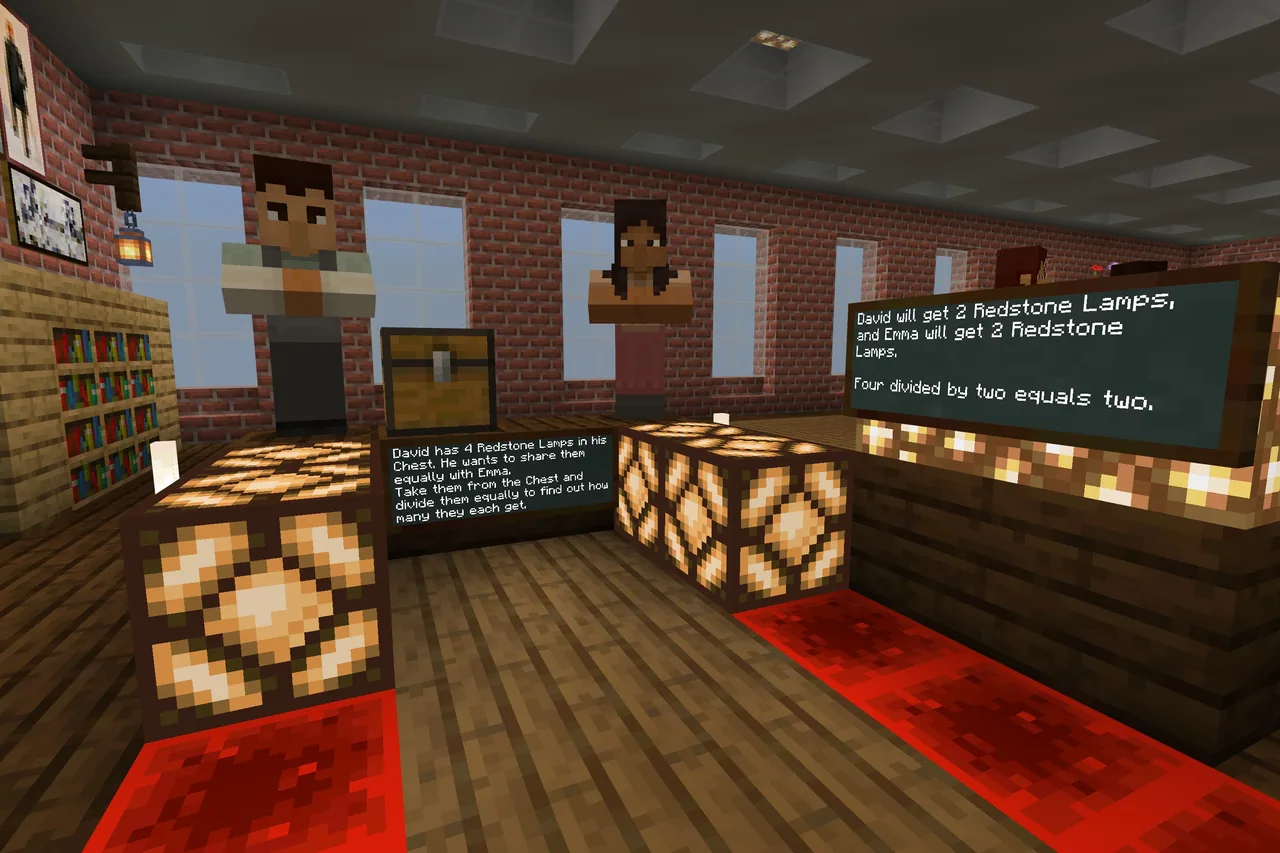
In Classroom Five, students approach six pairs of NPCs standing beside chests. Students take redstone lamps from each chest and divide them equally between the two characters, using rows of redstone blocks for visual counting and recording their results on blank boards.
- Multiplication Wall Showcase
Students conclude in Classroom Six by testing levers for equations 2 x 1 through 2 x 5. Each lever activates a decorative wall of redstone lamps to visually confirm the calculated total.
Assessment: success criteria
- Student accurately answers the NPC multiple-choice checks for 1 x 1 through 1 x 10.
- Student correctly separates redstone lamps into two equal portions for each NPC pair in Classroom Five.
- Student articulates that reorganizing objects in Classroom Four does not change the total amount.
Differentiation
Allow students who need tactile support to place redstone lamps onto the designated classroom spaces to count totals one by one.
Ask early finishers in Classroom Six to explain the mathematical relationship between the 1-times table and the 2-times table displays.
Knowledge check
5 questions to check understanding after the lesson. Tap an answer to see if it is right; the score appears at the end.
1How does this lesson explain the concept of basic multiplication?
Answer: B. The lesson introduces multiplication as repeated addition, such as showing that 1 x 3 equals 1 + 1 + 1.
2Why must in-game music be turned off while sound remains turned on in Classroom One?
Answer: A. Classroom One pairs redstone lamps with note blocks so students experience audio and visual cues together without musical distraction.
3What should students do if they need extra help answering NPC questions in Classrooms Two and Three?
Answer: B. Chests with redstone lamps and dedicated placement spaces are provided at each question to assist learners.
4What core principle does Classroom Four demonstrate using wall displays?
Answer: C. Classroom Four demonstrates the concept of 'equal to' by showing that changing formation does not alter the quantity.
5What is the goal of the activity in Classroom Five?
Answer: C. In Classroom Five, students practice division through fair sharing by splitting lamps equally between two NPCs.
Resources
- Lesson package (.zip)Everything the author attached to this lesson in one download.
- Multiplication and Division M:EE worldmcworld file. Download and open with Minecraft: Education Edition to import the world.
- Lesson worldOpens the world page in Minecraft Education (sign-in with a school account may be needed).
Frequently Asked Questions
Which game mode should students use for this lesson?
Students must remain in Adventure mode so that the classroom structures and interactive redstone circuits are preserved while still allowing them to interact with levers, chests, and designated placement spaces.
How are students alerted if their answers are correct or incorrect?
In Classrooms Two and Three, choosing an answer on an NPC triggers immediate text feedback directly on the player heads-up display.
Adapted from Multiplication and Division by Mathew House on Minecraft Education, last updated Jul 16, 2025. This classroom version, the timings and the quiz were written by 9Minecraft Education.