- Type
- Lesson plan
- Ages
- Ages 8-13
- Duration
- 45 min
- Level
- Beginner
How can astronauts design a sustainable lunar habitat that overcomes the environmental challenges of specific Moon terrains?
Overview
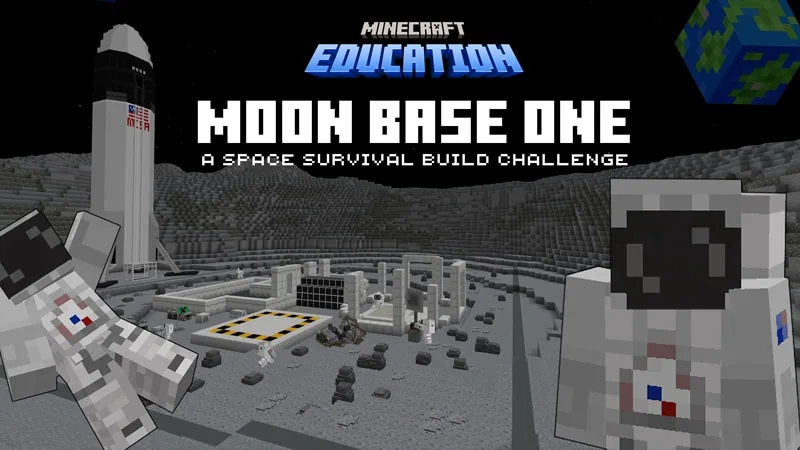
Drawing inspiration from NASA's Artemis program, this lesson immerses students in the challenges of long-term lunar habitation. Working individually or in collaborative crews, learners investigate how location, limited resources, and environmental hazards influence the architecture and systems needed to sustain human life on the Moon.
Using Minecraft Education in either Creative or Survival mode, learners select from five specific geographic regions—including mountains, craters, foothills, lava tubes, and lava fields. In their assigned zones, students construct functional habitats, record their work with the in-game camera, and reflect on their survival design choices.
Learning objectives
By the end of this lesson students will be able to:
- Design a functional lunar habitat tailored to a chosen Moon terrain.
- Plan life support and sustainable power systems for long-term lunar survival.
- Collaborate effectively in teams using either Creative or Survival game modes.
- Document and reflect on the completed lunar base using the in-game camera and journal.
Blocks and items used in this lesson


Key vocabulary
- Artemis Program
- NASA's space exploration initiative aimed at establishing a sustainable human presence on the Moon.
- Lava Tube
- A hollow underground tunnel formed by flowing lava that can shield astronauts from surface hazards.
- Crater
- A bowl-shaped depression on a planetary surface formed by meteorite impacts.
- Life Support System
- Equipment and infrastructure that supply air, water, and climate control to keep humans alive in space.
Before class
Lesson sequence
Suggested timing: about 45 minutes in total.
- Introduction and Mission Briefing10 min
Introduce NASA's Artemis program and the goal of establishing permanent lunar bases. Review the five team mission locations (Alpha Mountains, Delta Foothills, Zeta Crater, Sigma Lava Tubes, and Omega Lava Fields) and divide students into their operational roles.
- Site Selection and Base Construction25 min
Students join their designated game world in Creative or Survival mode, travel to their assigned team territory, and construct their habitat. Learners focus on incorporating essential life support, power generation, and environmental defenses suited to their biome.
- Documentation and Reflection10 min
Students use the in-game camera to photograph key features of their completed outpost. They write an entry in their in-game journal explaining their design choices, resource management strategies, and how the habitat handles local lunar hazards.
Video
Assessment: success criteria
- The student constructed a recognizable lunar habitat within the designated team territory.
- The build incorporates functional considerations such as shelter, power, or life support.
- The student captured photos of their base using the in-game camera.
- The student completed a written reflection in the in-game journal detailing their design choices.
Differentiation
Allow students to build in Creative mode where unlimited resources remove the pressure of resource gathering and survival damage.
Have students run their mission in Multiplayer Survival mode, requiring active resource management and protection from environmental risks.
Knowledge check
5 questions to check understanding after the lesson. Tap an answer to see if it is right; the score appears at the end.
1Which NASA initiative inspired the Moon Base One learning experience?
Answer: B. The lesson source states that Moon Base One was inspired by the NASA Artemis missions.
2What is the primary operational challenge faced by Team Sigma inside the lunar lava tubes?
Answer: B. Team Sigma's mission takes place inside lava tubes, which protect from surface hazards but limit sunlight and create a cold, dark expedition.
3Which team has the mission to construct an outpost surrounded by gorges where lava once flowed?
Answer: D. Team Omega is tasked with building a base in the flat lunar lava fields surrounded by ancient gorges.
4What technical requirement must be met for classroom students to join the same multiplayer world?
Answer: B. Minecraft Education allows players in the same Office 365 tenant to host and join classroom worlds via picture join codes.
5How are students instructed to record and assess their completed lunar station inside Minecraft?
Answer: A. The performance expectations state that students will capture photos with the camera and reflect in their in-game journal.
Resources
- Lesson package (.zip)Everything the author attached to this lesson in one download.
- Educator GuideTeachers guide to using the Moon Base One world in the classroom.
- Class PPT PresentationPowerpoint Presentation to assist with classroom instruction.
- Lesson worldOpens the world page in Minecraft Education (sign-in with a school account may be needed).
Frequently Asked Questions
Can this lesson be run as an individual activity instead of a group project?
Yes. The world supports four distinct gameplay formats: Single Player Creative, Single Player Survival, Multiplayer Creative, and Multiplayer Survival, allowing you to tailor the activity to your class arrangement.
What tools do students use to document their work inside the game?
Learners use the built-in Minecraft camera to capture screenshots of their completed habitat and record their operational notes directly in the in-game journal.
Adapted from Moon Base One by Minecraft Education on Minecraft Education, last updated Jul 21, 2025. This classroom version, the timings and the quiz were written by 9Minecraft Education.