- Type
- Lesson plan
- Subject
- Math
- Topics
- Math & Economics
- Ages
- Ages 6-10
- Duration
- 45 min
- Level
- Beginner
- Skills
- Critical thinking
How can we group smaller coin values into tens to exchange them for a 100-yen turn at a Gachapon machine?
Overview
Money exchange is a daily practical skill that relies on grouping smaller values into larger standardized units. In this lesson, students explore currency exchange and base-10 number concepts by assembling lower-denomination coins to reach a target sum of 100 yen.
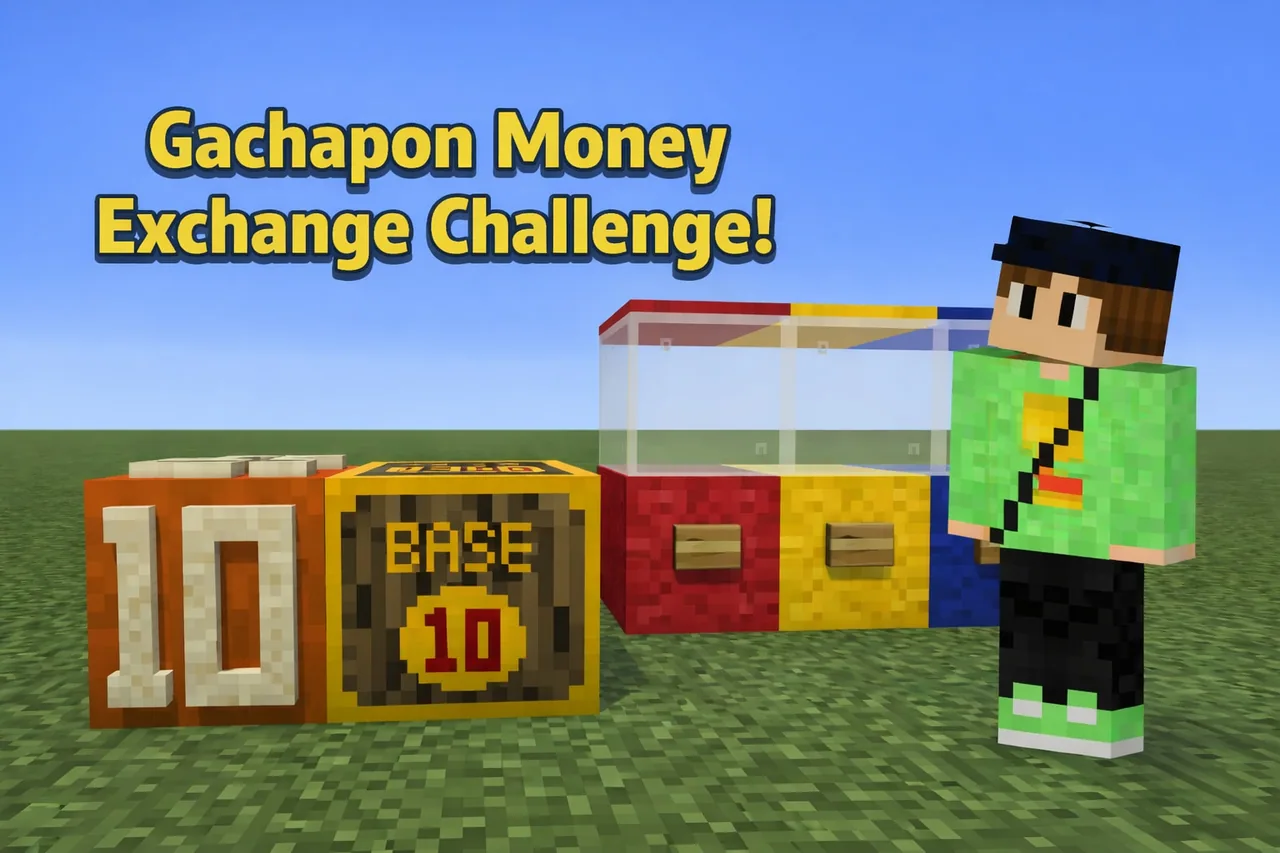
Using the Base 10 Math Chests Add-On in Minecraft, learners sort mixed blocks valued at 1, 5, 10, and 50 yen. By organizing smaller coins into sets of ten 10-yen units, students simulate plays on a decorative Gachapon machine, turning an abstract regrouping exercise into concrete, visual gameplay.
Learning objectives
By the end of this lesson students will be able to:
- Sort randomly mixed coin blocks inside a Base 10 Math Chest into distinct denominations.
- Combine lower-value coin blocks into sets of ten 10-yen units to total 100 yen.
- Calculate how many Gachapon plays can be made using the available coins.
- Explain mathematical grouping strategies and describe why remaining coin values cannot be exchanged.
Blocks and items used in this lesson


Key vocabulary
- Base-10
- A number system structured around tens, where ten units of one value equal one unit of the next value.
- Gachapon
- A toy vending machine that dispenses a prize when a set coin value is inserted.
- Money Exchange
- Trading an amount made of smaller coin denominations for an equivalent single value.
- Math Chest
- A specialized chest from the add-on used to hold and organize mathematical unit blocks.
Before class
Lesson sequence
Suggested timing: about 45 minutes in total.
- Introduction and Setup10 min
Present the learning challenge: students must fund plays on a decorative Gachapon machine that costs 100 yen per turn. Review the available coin denominations (1, 5, 10, and 50 yen) and explain that no 100-yen blocks are available in the chest.
- Sorting and Coin Grouping20 min
Students open the Base 10 Math Chest and organize the mixed coins to make counting easier. Using the Math Chests Add-On, they group smaller coins to assemble sets of ten 10-yen units to produce a 100-yen value. Observe student progress and ask guiding questions about how many tens are needed.
- Exchange and Play Simulation10 min
Each time students verify a complete 100-yen group, they simulate one turn on the Gachapon machine. Students continue exchanging sets until no further 100-yen totals can be made, identifying any leftover denominations that remain in the chest.
- Reflection and Reasoning5 min
Bring the class together to discuss the mathematical methods used. Have students describe how they reached their 100-yen totals, explain how many turns they earned, and account for why remaining coins could not be used.
Assessment: success criteria
- Correctly sorts mixed coin denominations inside the Base 10 Math Chest.
- Assembles combinations of smaller coins into sets of ten 10-yen units to total 100 yen.
- Accurately states the total number of Gachapon plays possible from the chest contents.
- Identifies remaining coins and explains why they cannot be converted into an additional turn.
Differentiation
Reduce the variety of coin types in the chest and supply mostly 10-yen blocks to simplify grouping.
Include a higher volume of 1-yen and 5-yen coins so students must perform multiple regrouping steps to reach 10-yen units.
Knowledge check
5 questions to check understanding after the lesson. Tap an answer to see if it is right; the score appears at the end.
1What total value is required to simulate one turn on the Gachapon machine?
Answer: B. A total of 100 yen is needed to take one turn on the machine.
2How many 10-yen units must be gathered to make one full 100-yen exchange?
Answer: C. Ten 10-yen units equal the 100-yen sum required for the exchange.
3Why is a 100-yen block omitted from the chest before the activity begins?
Answer: A. Leaving out the 100-yen block forces students to explore conceptual base-10 grouping rather than relying on automated units.
4Which denominations of coin blocks should the teacher place in the Math Chest?
Answer: B. The preparation notes specify using coin unit blocks of 1, 5, 10, and 50 yen.
5What should students do with coins that add up to less than 100 yen at the end of the activity?
Answer: D. Coins totaling less than 100 yen cannot form a complete turn and serve as unexchanged remainder values.
Resources
- Lesson package (.zip)Everything the author attached to this lesson in one download.
- What is a Gachapon?This is a Gachapon machine.In Japan, people use money to get a surprise toy. 100 yen = 1 turn.Prepare your money before you play.
- Why are the coins mixed in the chest?The coins are mixed on purpose.They represent scattered loose change. Students must organize the coins before counting.
Frequently Asked Questions
Does the Gachapon machine require complex redstone wiring to work?
No, the Gachapon machine can be constructed entirely from decorative blocks to serve as a visual goal for the students.
Where must the Math Chests Add-On be turned on in Minecraft?
You must activate the add-on in both the Behavior Pack and Resource Pack sections of the world settings before starting the lesson.
Adapted from Math Add-On: Gachapon Money Exchange Challenge by Takashi Doi on Minecraft Education, last updated Mar 16, 2026. This classroom version, the timings and the quiz were written by 9Minecraft Education.