- Type
- Lesson plan
- Ages
- Ages 8-13
- Includes
- Quiz: 5 questionsLesson files
How can the continuous stages of the water cycle be modeled accurately in a 3D environment?
Overview
Understanding the water cycle requires students to grasp how water continuously transitions between different physical states and ecological zones. In this project, learners explore the critical mechanisms of evaporation, transpiration, condensation, precipitation, runoff, and infiltration, connecting atmospheric processes with terrestrial landscapes.
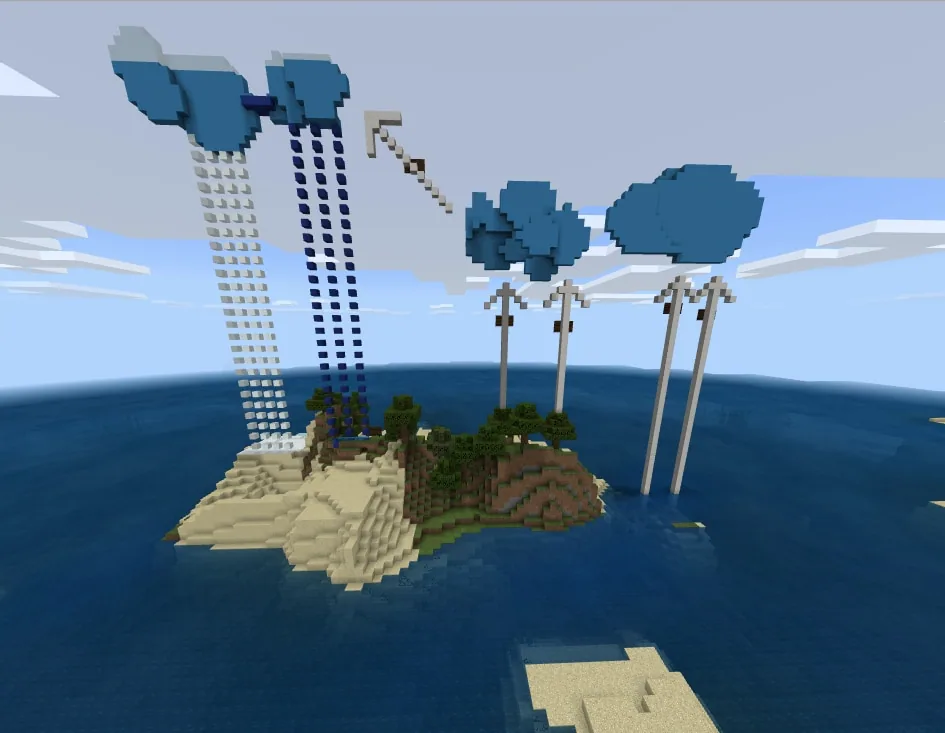
Using Minecraft Education, small groups work simultaneously within dedicated zones of an Ocean biome world. Students translate theoretical knowledge into static three-dimensional models, utilizing blocks creatively—such as glass and barrier-supported water—to illustrate both visible and invisible phases of the cycle.
Learning objectives
By the end of this lesson students will be able to:
- Identify the core stages of the water cycle: evaporation, transpiration, condensation, precipitation, runoff, and infiltration.
- Build a static 3D representation depicting each phase of the water cycle in Minecraft.
- Collaborate productively within an assigned group zone to produce a unified model.
Blocks and items used in this lesson


Key vocabulary
- Evaporation
- The process where liquid water absorbs heat and turns into water vapor.
- Transpiration
- The release of water vapor into the air from plant leaves and vegetation.
- Condensation
- The cooling of water vapor into liquid droplets, forming clouds.
- Precipitation
- Water released from clouds in forms such as rain, snow, sleet, or hail.
- Infiltration
- The process by which surface water soaks downward into soil and ground layers.
- Runoff
- Water from precipitation that flows over the ground surface into bodies of water.
Before class
Lesson sequence
- Research and Planning
Students review their Project Planning and Objectives Checklist. Working individually or in groups, they consult the curated iTunes U Science course and approved websites to study the water cycle phases.
- Zone Setup and Landscape Modification
Groups join the shared Ocean biome world and report to their designated quadrant. Because the environment is primarily aquatic, students add land areas, soil, and trees to enable the representation of transpiration, runoff, and infiltration.
- 3D Water Cycle Construction
Teams construct static 3D representations of each cycle stage. Students use blocks conceptually or literally, placing glass blocks to represent rising vapor, shaping clouds for condensation, and positioning water blocks with teacher-provided barriers for falling rain.
- Review and Discussion
The teacher observes builds through Classroom Mode, checking that each required phase is represented. Teams review their models against the initial checklist to verify complete coverage of all stages.
Assessment: success criteria
- The 3D model includes recognizable representations of evaporation, transpiration, and condensation.
- The build correctly demonstrates precipitation, runoff, and infiltration.
- The team completed their model collaboratively within their assigned quadrant using the provided checklist.
Differentiation
Allow students to represent abstract stages using clear visual metaphors, such as colored or transparent glass blocks to show water vapor.
Have students connect their completed water cycle models to UN Sustainable Development Goal 6 (Clean Water and Sanitation) and brainstorm solutions for clean water access.
Knowledge check
5 questions to check understanding after the lesson. Tap an answer to see if it is right; the score appears at the end.
1Which stage of the water cycle involves plants releasing water vapor into the air?
Answer: B. Transpiration specifically refers to the release of water vapor from plant leaves.
2What base world environment does the teacher prepare for this project?
Answer: D. The lesson outlines using a simple Ocean biome divided into designated areas for group work.
3What tool is recommended for the teacher to observe and guide student groups during the build?
Answer: A. The source specifies that the teacher should use Classroom Mode to orient and follow student progress.
4How can students hold water blocks in place mid-air to show precipitation?
Answer: C. The teacher can supply barrier blocks using the /give command so students can suspend water blocks.
5Which global goal can be used as an extension activity for this project?
Answer: B. The lesson suggests aligning the models with Sustainable Development Goal 6 to brainstorm clean water solutions.
Resources
Frequently Asked Questions
Are students required to create animations or write code for their water cycle models?
No. Students are expected to produce a static 3D representation of the cycle stages using standard creative building blocks rather than animations or code.
Why do students need to alter the Ocean biome before building the full cycle?
Because the starting environment is mostly open water, students must add landmasses and plant life to illustrate stages that occur on land, such as transpiration, runoff, and infiltration.
How does the teacher manage multiple groups working in the same Minecraft world?
The teacher partitions the base world into four distinct building zones so each group has its own space while using Classroom Mode to monitor activities across the entire map.
Adapted from Let it rain! Water Cycle by Andreia Salgueiro on Minecraft Education, last updated May 14, 2019. This classroom version, the timings and the quiz were written by 9Minecraft Education.