How can we minimize food waste in our school and transform leftovers through proper sorting and composting?
Overview
Food waste is an urgent global issue connected to sustainable development. Through this lesson, learners investigate where food is discarded across school and home environments, exploring how structured waste segregation and composting practices can redirect meal scraps away from trash heaps and back into productive ecological cycles.
Using Minecraft Education, students build practical models of sustainable school infrastructure. Learners construct classroom sorting hubs with separate receptacles for wet, dry, and plastic waste, engineer garden composting pits, investigate canteen waste practices, and use chemistry features to create reusable food packaging alternatives.
Learning objectives
By the end of this lesson students will be able to:
- Identify common causes and locations of food waste in daily life.
- Categorize discarded materials into dry, wet, and plastic waste streams.
- Construct an outdoor composting pit in Minecraft to manage biodegradable scraps.
- Formulate waste reduction and packaging solutions for school dining areas.
Blocks and items used in this lesson


Key vocabulary
- Sustainable Development Goals
- A collection of global objectives designed to address social, economic, and environmental challenges.
- Biodegradable Waste
- Organic matter such as fruit rinds and food scraps that can break down naturally over time.
- Composting
- The process of collecting and decomposing organic food remnants to produce nutrient-rich soil.
- Waste Segregation
- The practice of separating trash into distinct categories, such as dry goods, wet organics, and plastics.
Before class
Lesson sequence
Suggested timing: about 90 minutes in total.
- Introduction and Global Goals15 min
Introduce the lesson by screening the Global Goals video. Facilitate a discussion to check student awareness of the SDGs and identify the specific areas at school or home where food is wasted most frequently.
- Online Investigation15 min
Direct students to search online in the computer lab using Bing. Have them research effective techniques for curbing food waste in schools and gather step-by-step information on composting kitchen scraps like bread crusts and fruit peels.
- Classroom Sorting and Composting Build30 min
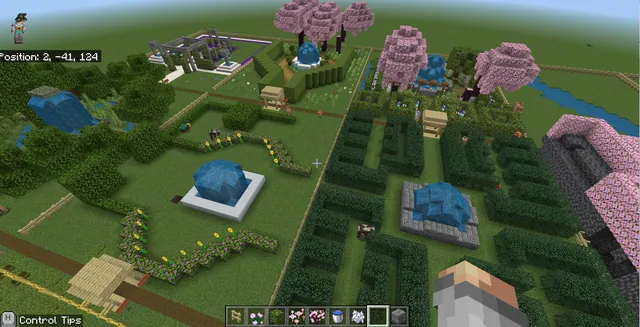
Students open Minecraft and construct a classroom featuring three distinct receptacles for dry waste, wet leftovers, and plastics. In the adjacent school garden, they build composting pits for wet organic waste and set up non-player characters to provide instructional tips.
- Canteen Survey and Packaging Lab20 min
Students navigate to a simulated school canteen to review waste disposal methods and assist kitchen staff with sorting. Using the chemistry update, learners develop reusable packaging substances to reduce disposable wrappers and photograph their creations with the in-game camera.
- Review and Brainstorming10 min
Bring the class together to review camera photos and discuss core findings. Encourage learners to brainstorm additional schoolwide initiatives to prevent food waste and sustain proper composting routines.
Assessment: success criteria
- Student accurately builds and labels three distinct bins for dry, wet, and plastic materials.
- Student constructs a garden composting pit designated specifically for biodegradable waste.
- Student sets up instructional non-player characters explaining composting or sorting procedures.
- Student identifies realistic methods to reduce and segregate waste generated in the school canteen.
Differentiation
Provide a simple visual sorting guide showing students which common meal items belong in wet, dry, or plastic receptacles.
Challenge students to use chemistry update crafting to develop reusable food wrap concepts and record a narrated tour using the in-game camera.
Knowledge check
5 questions to check understanding after the lesson. Tap an answer to see if it is right; the score appears at the end.
1Which category of waste includes fruit peels, bread crusts, and plate leftovers?
Answer: B. Fruit rinds and leftover food scraps are classified as wet or biodegradable waste suitable for composting.
2What is the primary function of a garden composting pit?
Answer: C. Composting pits allow organic and biodegradable materials to break down naturally into nutrient-rich compost.
3How many separate waste bins are all students expected to build in their virtual classroom?
Answer: A. Students are tasked with building three bins to separate dry waste, wet waste, and plastic waste.
4Which Minecraft Education feature allows learners to craft reusable food packaging materials?
Answer: D. The lesson utilizes the chemistry update so students can experiment with elements to create reusable packaging substances.
5What role do non-player characters (NPCs) play in the garden activity?
Answer: B. NPCs are placed by students to serve as guides that explain how to compost food scraps correctly.
Frequently Asked Questions
Do I need to download a specific custom world for this lesson?
No custom world download is required. Students can construct their classrooms, canteen areas, and garden composting pits in a standard Minecraft Education world.
How should students use the in-game camera during this project?
Learners can use the camera item to document their completed sorting bins, composting stations, and packaging experiments, creating a visual record for classroom sharing.
What if my students have never used the chemistry features before?
The chemistry portion is an extension activity. Students who are new to chemistry can focus primarily on the three-bin sorting system and garden composting build before testing element combinations.
Adapted from Journey of Food by Neeru Mittal on Minecraft Education, last updated Jun 14, 2018. This classroom version, the timings and the quiz were written by 9Minecraft Education.