- Type
- Lesson plan
- Ages
- Ages 8-18
- Duration
- about 1.6 hours (suggested)
What impacts did the Civil Rights Movement’s fight for racial justice and equality have on U.S. Society and the Black Community?
Overview
During the American Civil Rights Movement, activists challenged discriminatory laws and systemic racism through nonviolent protests, sit-ins, and marches. This lesson invites students to explore the historical context of racial injustice, Jim Crow legislation, and the courageous individuals who stood together to advocate for civil rights and social change.
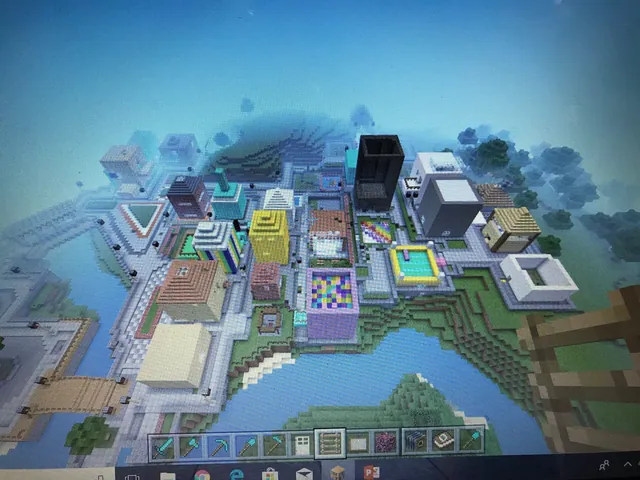
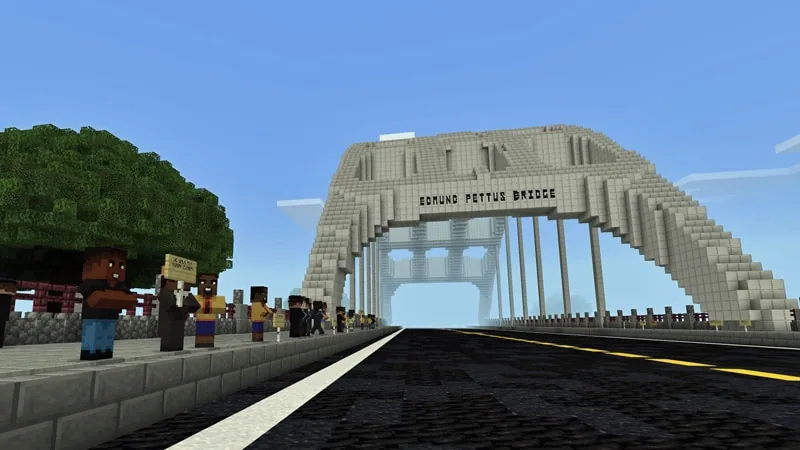
Using the Minecraft Education Good Trouble world, students take on the role of investigative journalists. By visiting recreations of key events such as the Greensboro lunch counter sit-in and the march at Edmund Pettus Bridge, learners interview historical figures, capture evidence with the in-game camera, and document their findings inside a Book and Quill.
Learning objectives
By the end of this lesson students will be able to:
- Identify key activists and historic events of the U.S. Civil Rights Movement.
- Explain how nonviolent strategies such as sit-ins and marches challenged segregation and Jim Crow laws.
- Document historical scenes inside Minecraft using the camera and Book and Quill from the perspective of an investigative reporter.
- Reflect on how Good Trouble promotes fairness and connects to standing up for others in daily life.
Blocks and items used in this lesson


Key vocabulary
- Segregation
- The enforced separation of different racial groups in daily life, such as in schools, businesses, and public facilities.
- Jim Crow Laws
- State and local statutes that legalized and enforced racial discrimination and segregation in the American South.
- Sit-in
- A nonviolent form of protest where demonstrators peacefully occupy a space and refuse to leave until their demands are met.
- Boycott
- A collective refusal to buy goods or use services as an organized effort to protest injustice.
- Integration
- The process of ending racial separation and bringing different racial groups together as equals in society.
- Good Trouble
- A phrase associated with John Lewis describing peaceful, necessary actions that disrupt unjust systems to create positive social change.
Before class
Lesson sequence
Suggested timing: about 95 minutes in total.
- Photo Analysis Gallery Walk20 min
Display historical photographs around the classroom, such as John Lewis at Edmund Pettus Bridge, the Greensboro Four, and lunch counter sit-ins. In small groups, students observe the photographs, record evidence to make inferences using their analysis sheets, and watch a selected video account of Bloody Sunday or John Lewis reflecting on Selma.
- World Entry and Greensboro Reflection15 min
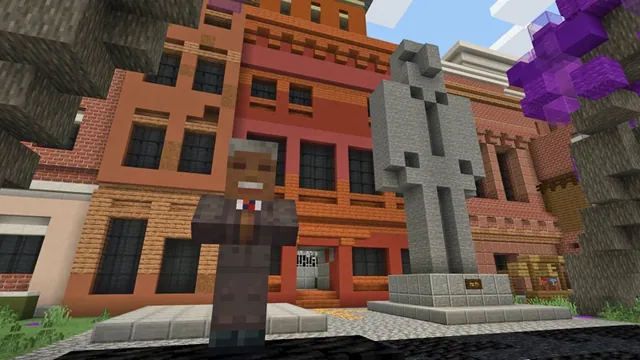
Students load the Good Trouble world and speak to Dr. Martin Luther King Jr. in the lobby to teleport into the Civil Rights environment. Outside Woolworth's, learners meet the Greensboro Four to understand their lunch counter sit-in. Students then write an initial reflection in their Book and Quill about a time they or a friend experienced exclusion.
- Investigative Reporter Exploration45 min
Assuming the role of investigative reporters, students explore the world to document major movement scenes. Learners use the in-game camera to snap 4 to 5 photos, including self-portraits, ensuring they cover young John Lewis at the Edmund Pettus Bridge, Rosa Parks, and the Greensboro Four. Inside the Book and Quill, students describe the setting, identify the people present, record their actions, and supplement their reporting with external research.
- Reflection and Book Export15 min
Students conclude by writing a closing entry in their Book and Quill answering why Good Trouble is sometimes necessary and sharing an example of standing up for someone else. Students export their completed Book and Quill to turn in or post to the class collection platform.
Assessment: success criteria
- Student Book and Quill includes 4 to 5 photos documenting key figures, including John Lewis, Rosa Parks, and the Greensboro Four.
- Investigative writing accurately describes what protesters are doing, whether scenes take place indoors or outdoors, and the historical context of each event.
- Written reflections articulate why peaceful resistance or Good Trouble is necessary when facing unjust laws.
- Student demonstrates accurate understanding of core concepts such as Jim Crow, segregation, and nonviolent protest.
Differentiation
Provide sentence frames for the Book and Quill reporting prompts (e.g., 'In this scene, I observe... They are protesting by...') and pair learners during the gallery walk.
Have students research additional historical context using the Civil Rights Trail interactive resources to add detailed captions and historical legislation outcomes to their report.
Knowledge check
5 questions to check understanding after the lesson. Tap an answer to see if it is right; the score appears at the end.
1Which nonviolent protest method was famously used by the Greensboro Four at Woolworth's?
Answer: A. The Greensboro Four staged a sit-in at a segregated Woolworth's lunch counter to protest racial segregation.
2Which historical figure do students click on in the Good Trouble lobby to enter the Civil Rights Movement area?
Answer: C. The lesson instructions direct students to click on Dr. Martin Luther King Jr. in the lobby to teleport to the Civil Rights Movement.
3What in-game item do students use to document photos and write their investigative reports?
Answer: B. Students are directed to use the Minecraft camera and record their reporting and reflections inside a Book and Quill.
4Which location is specifically associated with young John Lewis in the lesson's reporting checklist?
Answer: D. The investigative reporter checklist requires students to include Young John Lewis at the Edmund Pettus Bridge in Selma, AL.
5What was the primary purpose of Jim Crow laws in the American South?
Answer: B. Jim Crow laws were legal systems established to mandate segregation and deny rights to the Black community.
Resources
- Lesson package (.zip)Everything the author attached to this lesson in one download.
- Good Trouble: US Civil Rights VocabularyThis is the vocabulary for the Minecraft Good Trouble: US Civil Rights Lesson
- Good Trouble: US Civil Rights Photo AnalysisStudents will use this document to analyze images from the US Civil Rights Movement
- Good Trouble: US Civil Rights Movement Full LessonThis is the full lesson for the Minecraft Good Trouble: US Civil Rights Movement Lesson
Frequently Asked Questions
How do students export their completed investigative reports from Minecraft?
When students finish writing and placing pictures in their Book and Quill, they can sign and close the book, then click the export button to save the work as a PDF or text file to upload to the class platform.
Can this lesson be split across multiple class sessions?
Yes. A practical split is to complete the photo analysis and pre-teaching on day one, conduct the in-game investigative reporting on day two, and finish with research, reflection, and exporting on day three.
Adapted from Good Trouble: US Civil Rights by Felisa Ford, Ken Shelton, Natasha Rachell on Minecraft Education, last updated Jul 14, 2025. This classroom version, the timings and the quiz were written by 9Minecraft Education.