- Type
- Lesson plan
- Ages
- Ages 8-13
- Duration
- 30 min
- Level
- Beginner
How do healthcare teams use specialized tools and procedures to detect and diagnose cancer?
Overview
Cancer affects thousands of families every year, yet many young learners misunderstand the illness or carry unnecessary fear and stigma. This lesson provides an age-appropriate, compassionate introduction to cancer literacy, encouraging open conversation while teaching children how the human body is affected and how healthcare teams work together.
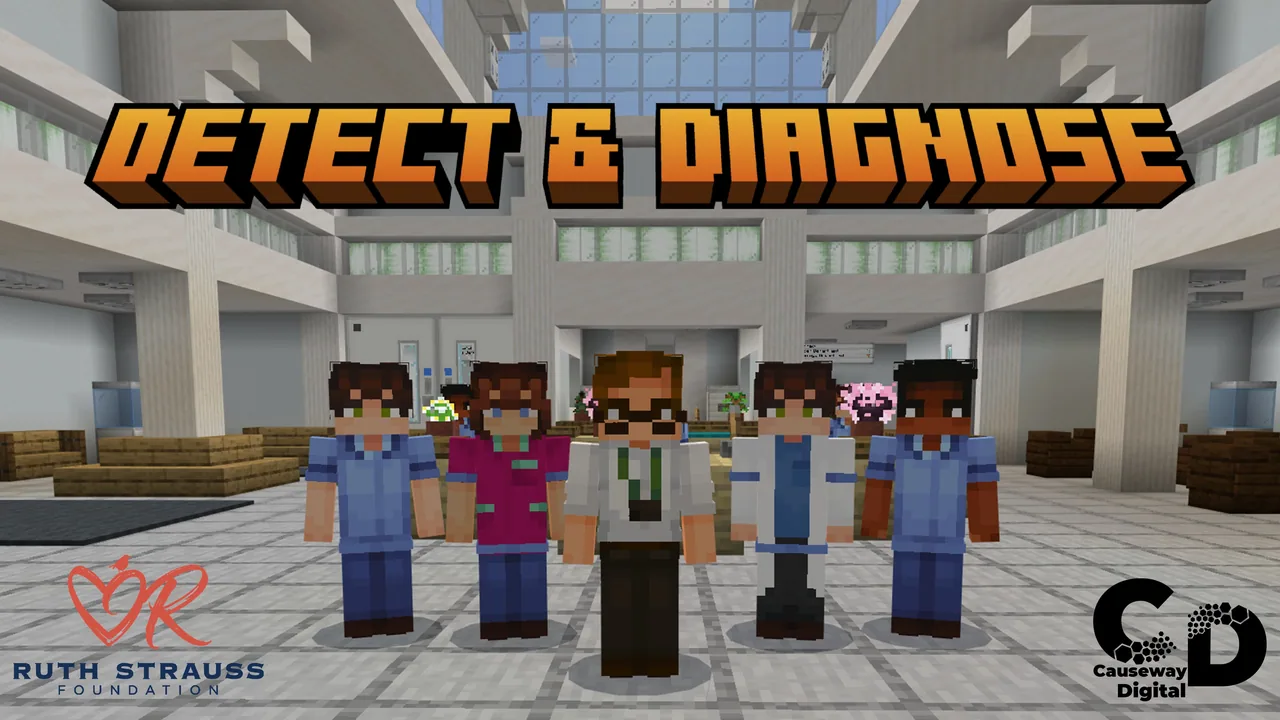
Stepping into a simulated hospital as first-day medical trainees, students collaborate with doctors, radiologists, surgeons, and pathologists. Through interactive hospital tasks, learners review authentic scans, assist with diagnostic lung biopsies, and discover the essential laboratory steps required to evaluate tumour tissue.
Learning objectives
By the end of this lesson students will be able to:
- Identify key roles of healthcare workers involved in cancer diagnosis, including radiologists, surgeons, and pathologists.
- Describe what cancer is and recognize that tumours can develop in different parts of the human body.
- Explain the purpose of diagnostic procedures such as CT scans and tissue biopsies in identifying illness.
- Participate in respectful classroom discussions about illness, medical care, and bereavement using clear, factual language.
Blocks and items used in this lesson


Key vocabulary
- Tumour
- An abnormal growth or lump of tissue in the body that doctors inspect during cancer diagnosis.
- Radiologist
- A specialist doctor who examines internal medical images, such as CT scans, to detect signs of disease.
- Pathologist
- A doctor who studies and prepares body tissue samples in a laboratory to understand diseases.
- Bronchoscopy
- A procedure where a doctor looks inside the lungs and can take a small biopsy sample of a tumour.
- Biopsy
- The removal of a small piece of tissue from the body so it can be analysed in a medical laboratory.
Before class
Lesson sequence
Suggested timing: about 60 minutes in total.
- Preparation and Setting the Stage10 min
Introduce the lesson by explaining that the class will visit a virtual hospital as first-day medical students. Clarify that while the lesson focuses on specific examples, cancer can take many different forms in various parts of the body.
Establish ground rules for respectful and sensitive discussion. Remind students that medical professionals speak openly and factually about health, illness, and dying.
- Hospital Diagnostic Investigations20 min
Students log in to the hospital world and rotate through medical departments to assist healthcare staff:
- Join a radiologist to examine CT scans and spot tumours.
- Work with a surgeon to perform a bronchoscopy inside the lungs to collect a biopsy sample.
- Help a pathologist prepare the tissue specimen for laboratory analysis.
- Interact with virtual patients and staff to understand different forms of cancer.
- Consolidation Workbook15 min
Have students step away from the game to complete their individual student workbooks. Learners summarize the diagnostic steps they observed, define medical roles, and record their understanding of how tumours are investigated.
- Class Reflection and Q&A15 min
Convene a whole-class circle to discuss key takeaways and address student questions. If learners ask complex medical questions that you cannot answer, reassure them that you will research the answer rather than guessing, avoiding medical misconceptions.
Ensure discussions use clear terms like dead and died if bereavement is raised, avoiding vague euphemisms that can confuse children.
Assessment: success criteria
- Student accurately matches hospital roles (radiologist, surgeon, pathologist) to their specific diagnostic duties.
- Student explains the connection between taking a tissue biopsy and testing it in a pathology lab.
- Student completes the workbook activities demonstrating basic cancer literacy.
- Student participates in discussions using clear, respectful terminology without spreading misconceptions.
Differentiation
Allow learners to navigate hospital departments in pairs so they can read patient dialogues and review CT scans together.
Ask fast finishers to write a trainee doctor's summary log describing the step-by-step path a sample takes from patient scan to laboratory analysis.
Knowledge check
5 questions to check understanding after the lesson. Tap an answer to see if it is right; the score appears at the end.
1Which medical specialist works with students in the game to spot tumours on CT scans?
Answer: B. In the lesson, students work alongside a radiologist to examine real CT scans for signs of tumours.
2What procedure do students carry out alongside a surgeon to take a tissue sample from the lungs?
Answer: D. Students explore inside the lungs and conduct a bronchoscopy biopsy with a surgeon.
3What is the primary role of the pathologist that students assist in the virtual hospital?
Answer: A. Students assist the pathologist by preparing collected tumour samples so they can be analysed.
4What communication advice does the lesson provide when addressing death and dying with young learners?
Answer: C. The teacher guidance instructs educators to use direct language like 'dead' and 'died' instead of confusing euphemisms.
5Which organization created the Detect & Diagnose Minecraft learning world?
Answer: B. The game was developed for Minecraft Education by the Ruth Strauss Foundation to support cancer awareness for children.
Resources
- Lesson package (.zip)Everything the author attached to this lesson in one download.
- Educator GuideEducator Guide
- Student WorkbookStudent Workbook
- A guide for printing the student workbook.A guide for printing the student workbook.
- Parent letter templateParent letter template
- Lesson worldOpens the world page in Minecraft Education (sign-in with a school account may be needed).
Frequently Asked Questions
What should I do if a student asks a medical question I cannot answer?
Do not guess or improvise an answer. Tell the student honestly that you do not know but will find out the correct information for them, which protects children from developing medical misconceptions.
How can I support children who may have personal experiences with family illness?
Be mindful that some students may have family members undergoing diagnosis or treatment, and others may not be aware of a diagnosis. Use the parent letter template prior to teaching to inform guardians, maintain a safe emotional space, and keep language calm, factual, and supportive.
Adapted from Detect & Diagnose by Causeway Digital on Minecraft Education, last updated Jul 29, 2026. This classroom version, the timings and the quiz were written by 9Minecraft Education.