- Type
- Lesson plan
- Grade
- Primary (Grades 3-5)
- Ages
- Ages 8-10
- Includes
- Quiz: 5 questions
How can building and dividing block arrays help us visualize and solve multiplication problems?
Overview
Visualizing multiplication through arrays helps students understand how factors combine to form a product, especially when tackling facts within 100. Constructing rows and columns out of concrete items allows learners to see the relationship between area models and arithmetic equations.
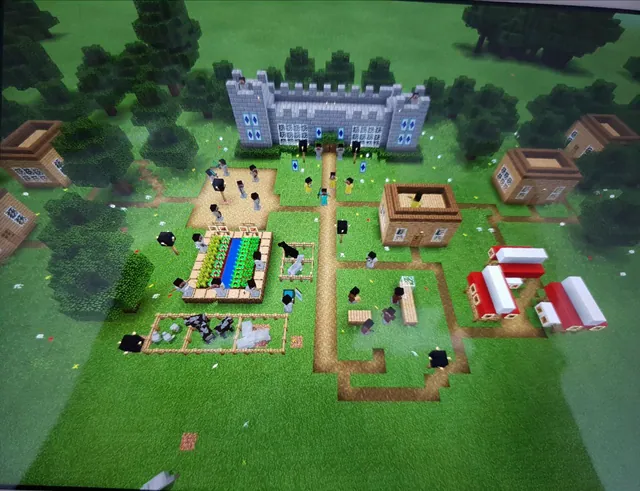
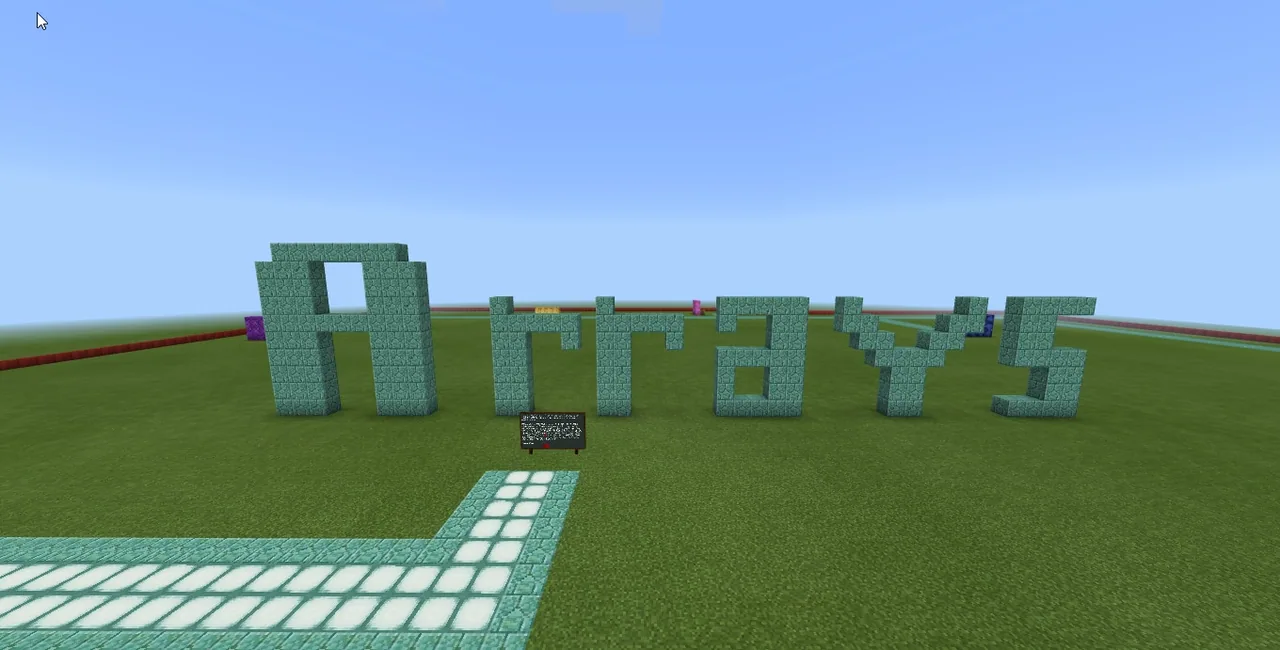
In this lesson, students enter a dedicated world where ten non-player characters present increasingly challenging multiplication tasks. Students build colorful block arrays to solve each equation, divide larger arrays using fences to model the distributive property, and record their builds and written math statements in a portfolio for assessment.
Learning objectives
By the end of this lesson students will be able to:
- Build block arrays to represent and solve multiplication problems within 100.
- Apply the distributive property by separating an array into two smaller groups using fence blocks.
- Document mathematical thinking by taking photos and typing corresponding equations and answers into a portfolio.
- Export a completed portfolio containing ten solved problems for teacher review.
Blocks and items used in this lesson


Key vocabulary
- Array
- An orderly arrangement of objects or blocks in equal rows and columns representing a multiplication equation.
- Distributive Property
- A multiplication principle allowing a problem to be broken down into the sum of two smaller multiplication problems.
- Non-Player Character (NPC)
- An in-game character that provides spoken instructions, supplies, or external links.
- Portfolio
- An in-game documentation book where students save camera photos and type text captions.
Before class
Lesson sequence
- Orientation and Equipment
Students spawn at a directional sign and locate the first NPC, Janie. Janie provides each student with a camera and portfolio, outlines expectations, and directs them toward the next NPC.
- Building Basic Arrays
Students travel through the map to encounter early NPCs offering single-digit multiplication tasks. For each challenge, learners place colorful blocks in rows and columns to visually calculate the product, take a photo, and type the matching equation and solution in their portfolio.
- Applying the Distributive Property
As problems increase in difficulty to double-digit factors, NPCs invite students to follow a link to an explanatory video. Students then apply the distributive property by placing a fence across their block array to split it into two manageable groups before documenting the result.
- Portfolio Export and Review
After working through all 10 NPCs, students verify that each entry contains a clear picture and the typed equation with its answer. Students export the completed portfolio file and submit it to the teacher.
Assessment: success criteria
- Student constructs block arrays that correctly represent the factors of each assigned multiplication problem.
- Student uses fence blocks to accurately partition larger arrays into two sub-problems reflecting the distributive property.
- Portfolio contains ten complete entries with clear screenshots and accurately typed equations and answers.
- Student exports and submits the finalized portfolio file.
Differentiation
Direct students to rewatch the distributive property video and practice dividing smaller single-digit arrays before moving to double-digit challenges.
Challenge students to demonstrate multiple ways to divide the same large array using fences to show alternate distributive property equations.
Knowledge check
5 questions to check understanding after the lesson. Tap an answer to see if it is right; the score appears at the end.
1Which NPC provides students with their camera and portfolio at the start of the lesson?
Answer: B. The source specifies that students first meet Janie, who distributes the camera and portfolio.
2How many total NPCs are placed in the world to assign multiplication problems?
Answer: C. The source notes that there are 10 NPCs altogether who present problems for students to solve.
3What specific item must students use to separate an array into two smaller groups?
Answer: A. The lesson instructions state students are expected to use a fence of some variety to divide the array.
4Dividing an array into two smaller groups demonstrates which mathematical property?
Answer: D. The source explains that splitting the array into two groups demonstrates the distributive property of multiplication.
5What information must be typed beneath each photo inside the portfolio?
Answer: B. The instructions state that each time a problem is solved, students take a photo and type out the equation and answer beneath it.
Frequently Asked Questions
How do students show their work to the teacher?
Students capture a photograph of each completed array, write the equation and product under the image in the in-game portfolio, and export the file to turn in once all ten problems are complete.
What support is available for students when the math problems become more difficult?
The in-game NPCs provide an external link to a video tutorial that demonstrates how to split an array into two parts using the distributive property.
Adapted from Arrays by Trish Cloud on Minecraft Education, last updated Jul 16, 2025. This classroom version, the timings and the quiz were written by 9Minecraft Education.