How can we design and build a safe, expanded underwater habitat to replace a damaged research lab?
Overview
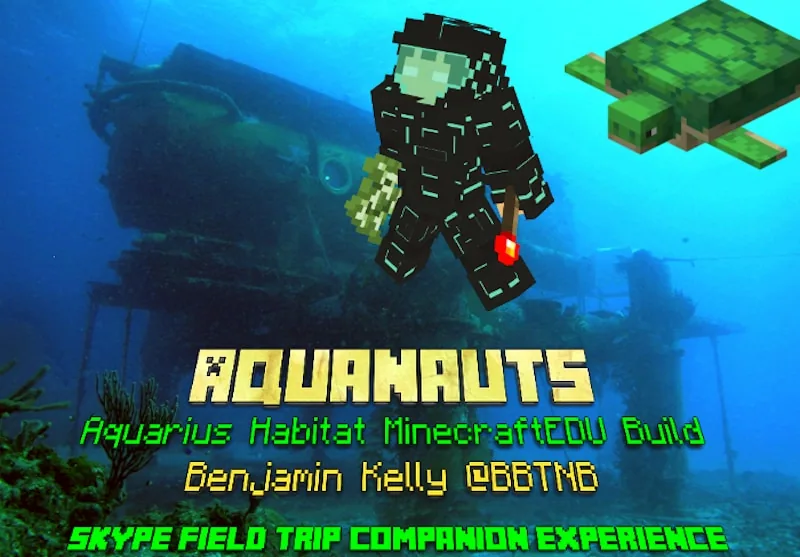
Hurricane Irma caused severe damage to the original Aquarius Habitat (AH1). In this project-based learning experience, students act as marine designers and researchers tasked with creating Aquarius Habitat II (AH2) for Florida International University and NASA, scaling the facility from 4 to 30 divers while prioritizing diver safety and scientific research.
Using Minecraft, students review historical plans, media, and expert notes to collaboratively build their new reef lab on the ocean floor near AH1. Learners implement safety innovations such as air gazebos, then set out as dive teams to explore surrounding trenches, caves, coral reefs, and temples while recording documentation in their portfolios.
Learning objectives
By the end of this lesson students will be able to:
- Analyze media, plans, and notes from AH1 to determine design needs for AH2.
- Collaborate to build Aquarius Habitat II on the seafloor to support up to 30 divers.
- Incorporate diver safety innovations, including air gazebos, into the habitat design.
- Explore underwater environments, capturing photos and observational notes in a portfolio.
Blocks and items used in this lesson
 Camera
 Book
 Sea Lantern
 Glass
 Prismarine
Key vocabulary
- Aquanaut
- A diver who lives and works inside an underwater habitat for an extended duration.
- Air Gazebo
- An underwater structure that provides an air pocket for divers to rest, communicate, and stay safe.
- Aquarius Habitat
- An underwater marine laboratory situated on the ocean floor for scientific research.
Before class
Lesson sequence
- Research and Briefing
Introduce the mission context: AH1 sustained severe damage from Hurricane Irma. Students review plans, media, and expert notes—or participate in an optional Skype Field Trip with the Aquarius Team—to understand how the original base operated.
- Habitat Planning
Students analyze the challenge of expanding the facility from 4 divers to 30 divers for Florida International University and NASA. Teams draft plans for AH2, identifying necessary research spaces and safety features like air gazebos.
- Collaborative Construction
Working in teams on the seafloor a short distance from AH1, students construct Aquarius Habitat II. They ensure the lab includes functional research areas, diver accommodations, and designated safety features.
- Seafloor Expedition
Organized into dive teams, students venture out to explore AH1, deep sea trenches, underwater caves, two temples, and a large coral reef, collecting photos and field notes in their portfolios.
- Reflection and Review
Learners present their completed habitat, justifying the features they added, modified, or left out, and reflect on how their preparation and research supported the build.
Assessment: success criteria
- Construction of an underwater habitat that scales capacity to accommodate up to 30 divers.
- Integration of diver safety innovations, such as air gazebos, within the design.
- Completion of a portfolio containing notes and captured images of AH1, reefs, trenches, caves, and temples.
- Clear communication explaining why specific design choices and modifications were made.
Differentiation
Provide labeled floor plans of AH1 and assign specific, manageable sections of AH2, such as diver bunks or an air gazebo.
Challenge students to design specialized onboard laboratories tailored to complex climate science and NASA research missions.
Knowledge check
5 questions to check understanding after the lesson. Tap an answer to see if it is right; the score appears at the end.
1What real-world event severely damaged the original Aquarius Habitat (AH1)?
Answer: A. The source notes that Hurricane Irma badly damaged the original AH1 habitat.
2How many divers does the new Aquarius Habitat II need to accommodate?
Answer: C. The guiding ideas ask students to adjust the habitat requirements from 4 divers to 30 divers.
3What innovation are students asked to construct to enhance diver safety?
Answer: B. The source specifically mentions building air gazebos to improve diver safety.
4Which underwater landmarks are dive teams tasked with exploring and documenting?
Answer: D. The student activities specify exploring deep sea trenches, caves, AH1, two temples, and a large coral reef.
5Which two organizations are named as partners for the Aquarius Habitat II build?
Answer: A. The lesson lists Florida International University (FIU) and NASA in the activities and performance expectations.
Resources
- Lesson package (.zip)Everything the author attached to this lesson in one download.
- Project Title CardTitle Card
- Screen Shot 1Screen Shot 1
Frequently Asked Questions
Is the Skype Field Trip required to teach this lesson?
No, the Skype Field Trip is listed as optional. Teachers can use provided plans, media, and NPC dialogues to deliver the necessary background information if a live session cannot be scheduled.
Does this lesson provide a downloadable Minecraft world file?
No world file is included with the lesson. Teachers can host an underwater area in a standard Minecraft world that features ocean trenches, reefs, and open space for habitat construction.
Adapted from Aquanaut Aquarius - Habitat II by Benjamin Kelly on Minecraft Education, last updated Aug 20, 2018. This classroom version, the timings and the quiz were written by 9Minecraft Education.