- Type
- Lesson plan
- Ages
- Ages 8+
- Duration
- 45 min
- Level
- Beginner
- Includes
- Quiz: 5 questionsMinecraft world
How do teams plan, communicate, and evaluate their performance to improve their work together?
Overview
Teamwork, communication, and deliberate reflection are vital components of collaborative problem-solving and esports. In this lesson, students learn how to organize within a group, establish shared criteria for evaluating work, and look critically at their own decisions to improve future performance.Learning objectives
By the end of this lesson students will be able to:
- Apply coding skills collaboratively within a team build challenge.
- Develop and use shared success criteria for peer assessment.
- Translate two-dimensional concepts into three-dimensional builds in the game.
- Reflect on individual and group performance in a play journal to set future goals.
Blocks and items used in this lesson


Key vocabulary
- Success Criteria
- A pre-agreed set of standards used to assess whether a build or task meets its goals.
- Shoutcaster
- An announcer who commentates and explains the live action of an esports match.
- Peer Assessment
- The process of reviewing, evaluating, and offering feedback on classmates' work.
- Reflection
- Thinking carefully about past actions and teamwork to identify areas for improvement.
Before class
Lesson sequence
Suggested timing: about 45 minutes in total.
- Criteria & Challenge Setup10 min
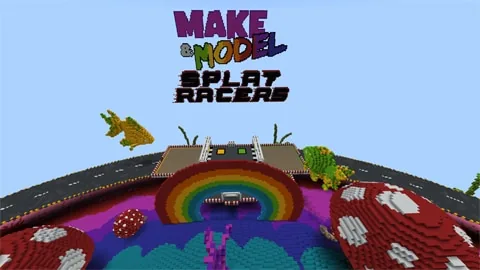
Introduce the fantasy racecourse theme and propose an object to build based on student input or skill level. Collaborate with the class to define clear success criteria so learners know how builds will be judged at the end.
- Spatial Thinking Warm-up5 min
Display a 2D image of a geometric shape and challenge groups to construct it in 3D, or have groups build a shape in-game for peers to sketch on paper to practice spatial visualization.
- The Build Battle15 min
Teams of 4 to 6 players code and build their creations simultaneously. Assign spectating students active roles such as shoutcasters, press and media, coaches, or gameplay analysts to support the event.
- Peer Assessment & Voting5 min
Spectators review the finished builds against the agreed criteria. Students then step onto the designated voting platforms to cast their votes within the allotted time limit.
- Journal Reflection & Goal Setting10 min
Students write in their Professional Play journals using guided reflection questions. They evaluate their group communication, recognize personal strengths, and set specific targets for their next team project.
Assessment: success criteria
- Student collaborates actively and communicates effectively within a 4 to 6 player team.
- Student evaluates peer builds using pre-established success criteria on the voting platforms.
- Student completes a reflective journal entry identifying strengths and setting actionable goals for future play.
Differentiation
Provide simple 2D geometric diagrams for the build and assign defined team sub-tasks to simplify collaboration.
Assign advanced spectator roles such as gameplay analyst or shoutcaster, or challenge teams to code complex geometric structures.
Knowledge check
5 questions to check understanding after the lesson. Tap an answer to see if it is right; the score appears at the end.
1What is the recommended team size for this build battle activity?
Answer: B. The lesson specifically recommends forming teams of 4 to 6 players.
2How do student spectators cast their votes for the winning creation?
Answer: C. Students vote by physically positioning their avatars on allocated voting platforms.
3What visual features characterize the setting of this lesson's world?
Answer: A. The world description highlights a fantasy island setting with rainbows, butterflies, and air-breathing fish.
4Which of the following is an auxiliary role suggested for spectating students?
Answer: C. Spectators can take on roles such as shoutcaster, press and media, coach, or gameplay analyst.
5What is the main purpose of the Professional Play journal in this lesson?
Answer: D. Students use the journal to reflect on their collaboration and set goals for their next team activity.
Resources
Frequently Asked Questions
How can I keep students engaged if they are not on a building team?
Assign spectating students active esports roles such as shoutcasters, media reporters, team coaches, or gameplay analysts to ensure they stay involved throughout the battle.
Why is it important to set success criteria before starting the build?
Establishing criteria early ensures that students understand the expectations and gives spectators a fair, objective basis for voting on the winner.
What external teaching resources support this lesson plan?
Teachers can consult the Esports Educator framework for additional information and scaffolding approaches to enhance the learning experience.
Adapted from Make & Model: Splat Racers by Minecraft Education on Minecraft Education, last updated Mar 31, 2025. This classroom version, the timings and the quiz were written by 9Minecraft Education.