- Type
- Lesson plan
- Includes
- Quiz: 5 questions
How can we create an accurate, to-scale representation of our school or classroom using Minecraft blocks?
Overview
Translating physical spaces and objects into digital models requires a solid grasp of measurement, scale, and dimensional accuracy. Students examine the physical world using formal or informal measuring techniques and learn how proportional scaling bridges the gap between reality and virtual builds.
Minecraft: Education Edition acts as a hands-on modeling environment where blocks represent specific real-world units of measurement. In collaborative teams, learners select materials and calculate dimensions to construct accurate, scaled replicas of their school environment.
Learning objectives
By the end of this lesson students will be able to:
- Measure the length, height, and depth of real-world objects using formal or informal units.
- Determine an effective measurement scale to represent physical dimensions in Minecraft.
- Construct to-scale 3D replicas of physical classroom features using appropriate Minecraft blocks.
- Discuss and justify material and scale choices during collaborative peer presentations.
Blocks and items used in this lesson


Key vocabulary
- scale
- A fixed ratio used to represent real-world measurements with smaller or larger units in a model.
- formal units
- Standard measurement units used universally, such as meters or centimeters.
- informal units
- Non-standard measurement tools or items, like boxes or blocks, used to compare sizes.
- dimension
- The measurable extent of an object, such as its length, height, or depth.
Before class
Lesson sequence
- Explore & Identify Challenges
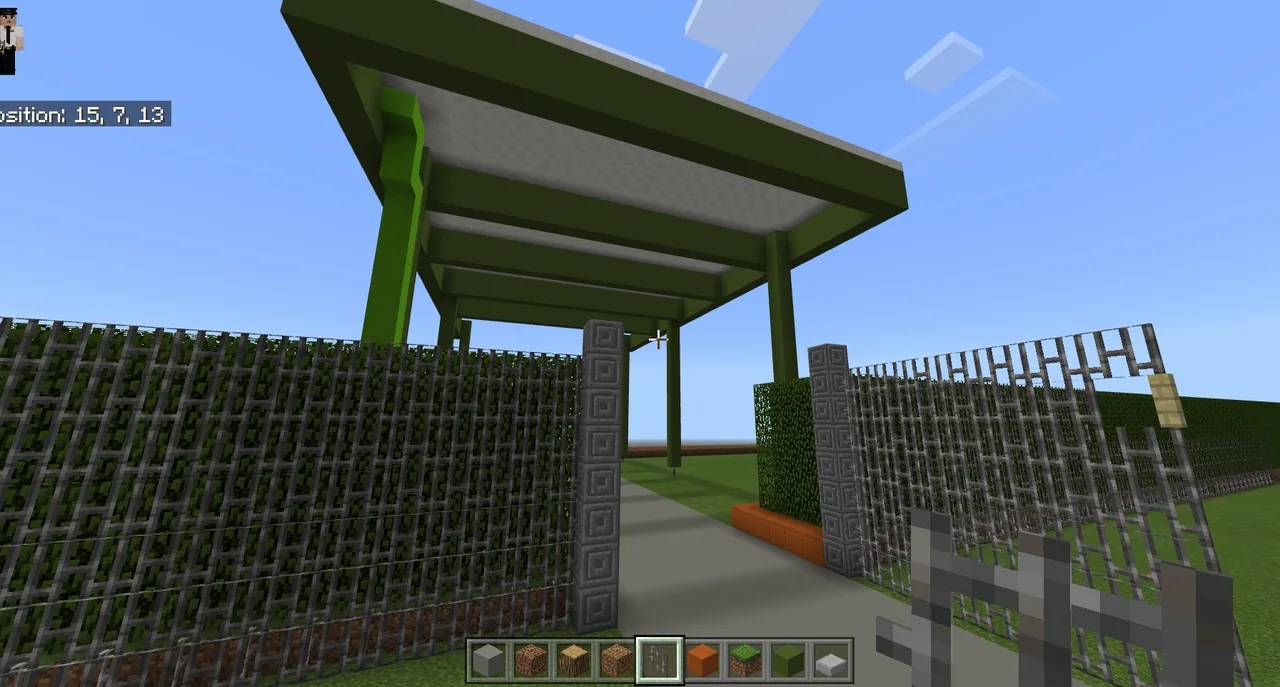
Introduce the task by having students pick a school feature and attempt to recreate it freely in Minecraft. Lead a reflection on challenges encountered, such as block size limits, representing curved or thin items like metal bars, and the need for closer physical examination.
- Scale Discussion & Modeling
Conduct a Think-Pair-Share on improving accuracy through measurement. Guide the class to establish a shared scale (such as one block equaling one meter, 50 cm, or 10 cm), record the ratio on a poster or whiteboard, and demonstrate modeling an object to scale on an interactive display.
- Measuring Jigsaw
Divide students into groups to measure the length, height, and depth of classroom furniture, structural features, or buildings using formal or informal units. Have teams record their data and report their findings back to the whole group.
- Collaborative Building & Presentation
In collaborative teams, students enter Creative mode on grass blocks to construct their measured objects to scale. Once finished, groups present their completed 3D builds to the class, explaining their material choices and dimension conversions.
Assessment: success criteria
- Accurately records length, height, and depth of classroom items using formal or informal measurement units.
- Applies the agreed measurement scale correctly to build a 3D replica in Minecraft.
- Participates in mathematical discussions to evaluate build challenges and justify material selections.
Differentiation
Use concrete informal units, such as square containers or base-1000 blocks, to help visualize measurement and scale.
Use school maps or satellite imagery with measuring tools to calculate perimeters and recreate entire school grounds or classrooms.
Knowledge check
5 questions to check understanding after the lesson. Tap an answer to see if it is right; the score appears at the end.
1Which of the following is a common challenge students face when recreating real-world items in Minecraft without a plan?
Answer: A. The source identifies block size and limitations in representing curved or thin items as key challenges.
2What is recommended for younger students when exploring units of measurement in this lesson?
Answer: B. The lesson suggests using informal units with concrete materials such as a square box, container, or base-1000 block for younger learners.
3What should the class decide together before building accurate representations?
Answer: C. The source directs the class to decide an appropriate scale for Minecraft blocks and record it for everyone to reference.
4In the jigsaw activity, what dimensions do students measure on classroom furniture and buildings?
Answer: D. The source specifies measuring and recording the length, height, and depth of classroom furniture, buildings, and structures.
5Which tool can be used for the large-scale extension project to measure the perimeter of the school?
Answer: B. The extension activity suggests using Google Maps satellite view with the measure tool or a school map to measure perimeters.
Frequently Asked Questions
What game mode and environment should students use for this lesson?
Students should work in collaborative teams using Creative mode in a standard world with blocks of grass.
How can this project be expanded beyond individual classroom objects?
You can extend the lesson into a larger project by having students recreate the entire classroom or school, using satellite maps or floor plans to measure perimeters and estimate the total blocks needed.
Is a specific downloadable custom world needed for this lesson?
No custom downloadable world is required; students can build directly in a standard Creative mode world.
Adapted from Minecraft Measurement by Thomas Keane on Minecraft Education, last updated Jul 10, 2018. This classroom version, the timings and the quiz were written by 9Minecraft Education.