- Type
- Lesson plan
- Duration
- about 5.2 hours (suggested)
- Includes
- Quiz: 5 questions
How does rotating design partners and communicating ideas impact the final outcome of a shared landmark?
Overview
In this multi-session project, students examine how collaborative teamwork and communication influence creative design. Working initially in pairs, students select a location, extract key facts, and begin planning and building a representative landmark in a shared world. Along the way, they practice the 4 Cs: collaboration, communication, creativity, and critical thinking.Learning objectives
By the end of this lesson students will be able to:
- Research an assigned location to identify three relevant factual details.
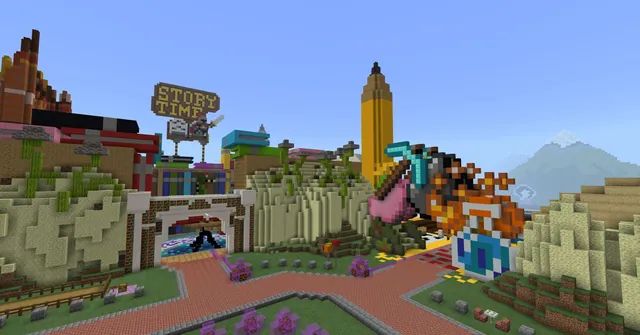
- Construct a landmark and informational signs representing the chosen location.
- Communicate architectural plans clearly to incoming peer partners during daily rotations.
- Document daily construction milestones using captioned in-game portfolio photographs.
- Analyze differences between the initial concept and final build in a collaborative presentation.
Blocks and items used in this lesson


Key vocabulary
- Landmark
- A prominent structure or feature that helps identify or represent a specific location.
- Portfolio
- An in-game camera and album system used to capture and caption visual records of student progress.
- The 4 Cs
- Four essential 21st-century skills: communication, collaboration, critical thinking, and creativity.
Before class
Lesson sequence
Suggested timing: about 315 minutes in total.
- Research and Project Launch45 min
Place students into pairs and have them draw a location from a hat. Partners research their assigned place, identify three facts, and record initial landmark ideas in OneNote Class Notebook or Google Docs.
Students enter the shared world to place two signs: one identifying their location and another displaying their research facts. Teams spend roughly 30 minutes beginning construction, taking portfolio photos, and adding captions before logging off.
- Daily Partner Rotations180 min
Across Days 2 through 5, conduct daily partner shifts. One student travels to a new build while the other stays behind to explain the site progress to the new visitor.
- Partners discuss the current build and negotiate design modifications.
- Students continue building together for the allocated session time.
- Each student takes new portfolio screenshots and adds captions before each day ends.
- The following day, the host rotates out while the newer student remains to host the next visitor.
- Reunion and Reflection Document45 min
On Day 6, original pairs reunite at their starting landmark to examine the finished structure. Partners discuss what they like, what they dislike, and how the landmark changed from their Day 1 blueprint.
Pairs work together in a shared document to record their original intentions, note differences and similarities in the finished work, and articulate personal reflections on the final outcome.
- Process Presentation45 min
Students assemble a final presentation using a digital tool of their choice, incorporating their captioned portfolio images to trace the construction timeline. Each pair presents their landmark, summarizes the project, and explains why their structure evolved away from the original plan.
Assessment: success criteria
- Build site includes a sign displaying the location name and another sign containing three accurate facts.
- In-game portfolio contains dated, captioned screenshots from each day of construction.
- Collaborative reflection document explains similarities, differences, and likes or dislikes regarding the design.
- Final presentation explains the process of building the landmark and why the outcome differed from the original vision.
Differentiation
Provide a structured reflection template with sentence frames to assist students during the daily handoff and final comparison.
Have advanced pairs research and incorporate complex regional architecture styles or represent made-up locations with deeper custom lore.
Knowledge check
5 questions to check understanding after the lesson. Tap an answer to see if it is right; the score appears at the end.
1How many facts are student pairs required to find during their initial location research?
Answer: C. The learning objectives require students to research their assigned location and pick out three facts.
2What is the primary responsibility of the student who stays behind during a rotation?
Answer: A. The student who stayed behind must explain what has been built so far and discuss possible design changes with the new partner.
3What daily documentation task must students complete in Minecraft before leaving each session?
Answer: B. Students are instructed to take pictures, place them in their portfolio, and add captions before the end of each day.
4What happens on Day 6 of the project?
Answer: C. On the sixth day, the original student pairs return to their starting location to see what was built and evaluate the changes.
5What must be included on the in-game signs placed at each landmark site?
Answer: B. Teams must post one sign naming their state or location and a second sign presenting informational facts about it.
Frequently Asked Questions
What digital platforms should students use for note-taking and reflections?
Students can record their initial ideas, research notes, and final written reflections using OneNote Class Notebook or Google Docs.
How many days does the rotation phase typically take?
The rotation process repeats across approximately five days, with partners alternating between hosting at a site and moving to a new build each day.
Adapted from Collaborative Design & the 4Cs by Patti Oakley DePriest on Minecraft Education, last updated Apr 13, 2017. This classroom version, the timings and the quiz were written by 9Minecraft Education.