- Type
- Build challenge
- Subject
- Computer Science & Coding
- Duration
- about 60 min (suggested)
- Includes
- Quiz: 5 questionsMinecraft world
How can fundamental logic gates and redstone circuits be used to design a secure vault entrance?
Overview
Computer hardware relies on fundamental logic gates to direct information, solve computational problems, and control systems. In this challenge, students step into the role of security engineers tasked with protecting valuable items inside a facility known as Redstone Labs. By examining how inputs and outputs interact, learners discover how computational logic forms the backbone of modern technology.
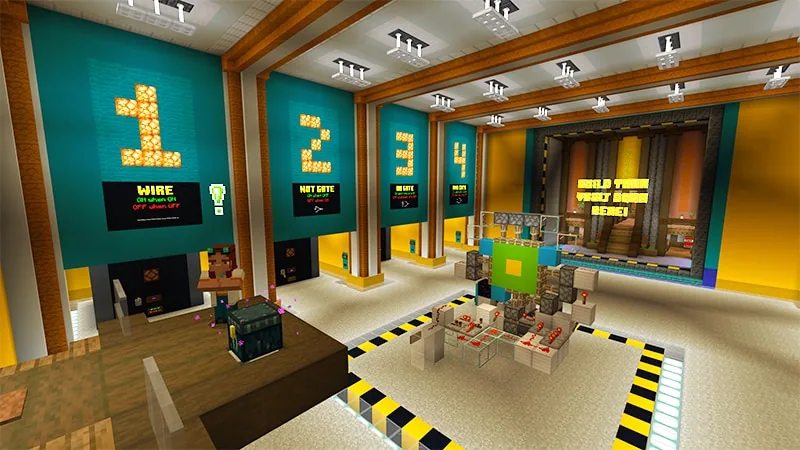
Minecraft provides a tactile environment for testing abstract circuits. Students examine demonstrations of seven essential logic gates, piston extenders, and mechanical doors before designing their own security entrances. Whether assembling a basic locking mechanism or an intricate gate powered by sticky pistons and observers, students apply critical thinking to make their vaults secure.
Learning objectives
By the end of this activity students will be able to:
- Identify how redstone components model logic gates, circuits, and black boxes.
- Examine functional security examples including piston extenders and multi-block redstone gates.
- Construct a secure vault entrance using redstone mechanisms such as lockable doors or piston assemblies.
- Apply critical thinking to troubleshoot and verify that the security mechanism functions as intended.
Blocks and items used in this lesson


Key vocabulary
- Logic Gate
- A basic building block of a circuit that takes inputs and produces an output based on a specific logical rule.
- Circuit
- A complete path through which an electrical or redstone signal can flow.
- Black Box
- A system or component viewed solely in terms of its inputs and outputs, without seeing its internal workings.
- Sticky Piston
- A mechanical block that pushes and pulls adjacent blocks when receiving a redstone signal.
- Observer
- A redstone block that detects state changes in the block directly in front of it and emits a short signal.
Before class
Lesson sequence
Suggested timing: about 60 minutes in total.
- Introduction & Concept Exploration10 min
Introduce the challenge scenario at Redstone Labs. Explain that students must safeguard vault treasures by understanding foundational computer science concepts, specifically circuits, black boxes, and the seven core logic gates.
- Mechanism Investigation15 min
Guide students through the demonstration area to inspect working models. Have them observe the seven logic gates in action, examine piston extenders, and analyze the mechanics of a functional 3x3 redstone gate.
- Vault Construction25 min
Direct students to design and construct their own vault entrance. Learners may assemble a simple lockable door or engineer a complex gate using sticky pistons, observers, and redstone logic circuits.
- Testing and Peer Review10 min
Allow students to test each other's vault locks to confirm reliability. Encourage them to verify whether the locking mechanisms work correctly and troubleshoot any circuit failures.
Assessment: success criteria
- Student successfully constructs an operational redstone locking mechanism or vault gate.
- Student demonstrates understanding of how input signals control output behavior in their build.
- Student uses critical thinking to diagnose and resolve circuit or mechanical issues.
- Student explains how their vault lock relates to logic gates or computer science principles.
Differentiation
Encourage students needing assistance to build a simple lockable door circuit before attempting piston-based gates.
Challenge advanced students to incorporate two-factor authentication, diagram their build with real-world circuit symbols, or explore math operations using logic gates.
Knowledge check
5 questions to check understanding after the lesson. Tap an answer to see if it is right; the score appears at the end.
1How many fundamental logic gates that power computers are highlighted in this challenge?
Answer: C. The challenge explicitly directs students to explore the 7 fundamental logic gates that make computers work.
2Which redstone component is combined with sticky pistons in the challenge description to build complex gates?
Answer: A. The challenge notes that students can build a complex gate using sticky pistons and observers.
3What large, fully functional mechanism example can students investigate in the challenge world?
Answer: B. The source states that learners can see an example of a fully functional 3x3 redstone gate.
4According to the extension activities, what security method can students research and add to their vault?
Answer: C. The extension prompts students to research two-factor authentication and incorporate it into their build.
5Beyond security doors, what practical task can logic gates execute according to the extension tasks?
Answer: A. The extensions list learning how logic gates are used to perform basic math operations.
Resources
Frequently Asked Questions
Do students need advanced redstone experience before starting this challenge?
No. The challenge includes foundational examples of logic gates and supports varying skill levels, allowing students to start with a simple lockable door before progressing to complex piston gates.
How can this challenge connect to real-world technology education?
Students learn the fundamentals of computer science by seeing how binary logic gates control outcomes, studying standard circuit diagram symbols, and exploring security ideas like two-factor authentication.
Adapted from Redstone Vault by Minecraft Education on Minecraft Education, last updated May 23, 2025. This classroom version, the timings and the quiz were written by 9Minecraft Education.