- Type
- Build challenge
- Subject
- Computer Science & Coding
- Topics
- Computer Science
- Duration
- about 60 min (suggested)
- Includes
- Quiz: 5 questionsMinecraft world
How can computer programming help us solve archaeological mysteries and understand historical settlements?
Overview
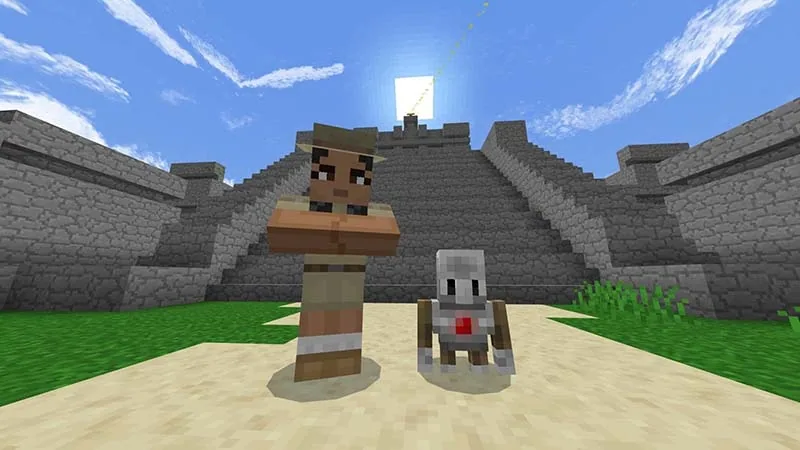
This challenge blends computer science and archaeological exploration by placing students in the historic ruins of Tulum. Learners navigate the ancient site to uncover clues, requiring analytical thinking to understand the environment and identify hidden pathways.
Students apply programming concepts by directing the Agent to solve targeted puzzles that unlock a concealed chamber. After uncovering the archaeological treasures, learners extend their work by researching historical trading settlements and recreating them inside creative building spaces.
Learning objectives
By the end of this activity students will be able to:
- Navigate the ruins of Tulum to locate clues leading to a hidden chamber.
- Program the Agent to solve a puzzle and unlock the secret room.
- Reconstruct Tulum as a historical trading settlement using creative build zones.
- Document findings and reconstructions using the camera and book and quill.
Blocks and items used in this lesson


Key vocabulary
- Agent
- A programmable helper in Minecraft Education used to execute coding commands.
- Tulum
- A walled Mayan coastal site that functioned as an active trading port between the 13th and 15th centuries.
- Archaeology
- The study of past human life and cultures through artifacts, structures, and physical remains.
Before class
Lesson sequence
Suggested timing: about 60 minutes in total.
- Site Exploration10 min
Direct students to enter the world and examine the ruins of Tulum. Encourage them to scout the site thoroughly to find environmental clues that hint at the location of the concealed chamber.
- Agent Programming20 min
Students open the coding interface and program the Agent to navigate the puzzle mechanisms. The code must be tested and adjusted until the secret room opens to reveal the hidden archaeological treasures.
- Trading City Reconstruction20 min
Using the designated creative spaces, students recreate Tulum based on how it functioned as a trading city during the 13th to 15th centuries. Encourage thoughtful layout design incorporating trading stalls, docks, or residential areas.
- Documentation and Reflection10 min
Students use the in-game camera to take photos of their completed builds and code sequences. They compile these images into a book and quill to share their architectural and programmatic decisions with the class.
Assessment: success criteria
- Student accurately writes and executes code for the Agent to complete the puzzle.
- Student successfully navigates into the secret room to access the archaeological artifacts.
- Student designs a build reflecting historical research on Tulum as an active trading center.
- Student presents an organized book and quill documenting their building and coding work.
Differentiation
Offer step-by-step pseudo-code guides or partner students to assist with programming the Agent.
Challenge students to research specific goods traded in Tulum between the 13th and 15th centuries and include dedicated storage or trade facilities for them.
Knowledge check
5 questions to check understanding after the lesson. Tap an answer to see if it is right; the score appears at the end.
1What tool or character is programmed to solve the puzzle in this world?
Answer: B. The source specifies that students work with the Agent to solve a coding puzzle.
2Which historic settlement serves as the setting for this challenge?
Answer: A. The challenge asks students to explore the historic ruins of Tulum.
3What primary curricular subject does this challenge focus on alongside creativity?
Answer: C. The source explicitly lists Computer Science as the featured subject.
4Between which centuries should students research Tulum's history as a trading city?
Answer: D. The extension prompts research on Tulum as a trading city between the 13th and 15th century.
5Which items are suggested for students to record and present their builds to classmates?
Answer: B. The extension activity instructs learners to use the camera and book and quill to document their work.
Resources
Frequently Asked Questions
Do students need prior coding experience to participate?
Basic familiarity with block-based coding is helpful, but the challenge provides an opportunity for learners to build coding proficiency through guided puzzle-solving with the Agent.
How can the extension activities fit into a history or social studies curriculum?
The extensions prompt students to research Mayan trade between the 13th and 15th centuries and recreate historic urban layouts, making it straightforward to connect computer science to world history units.
Adapted from Mayan Mystery by Minecraft Education on Minecraft Education, last updated May 6, 2025. This classroom version, the timings and the quiz were written by 9Minecraft Education.