- Type
- Build challenge
- Subject
- Science
- Topics
- Science
- Duration
- about 60 min (suggested)
- Includes
- Quiz: 5 questionsMinecraft world
How do honey bees support plant life cycles and human food production?
Overview
Honey bees play a critical role in global ecosystems and agriculture, pollinating approximately one third of the food that humans eat. Through pollination, plants complete an essential stage of their life cycle, enabling them to produce fruit and continue growing.
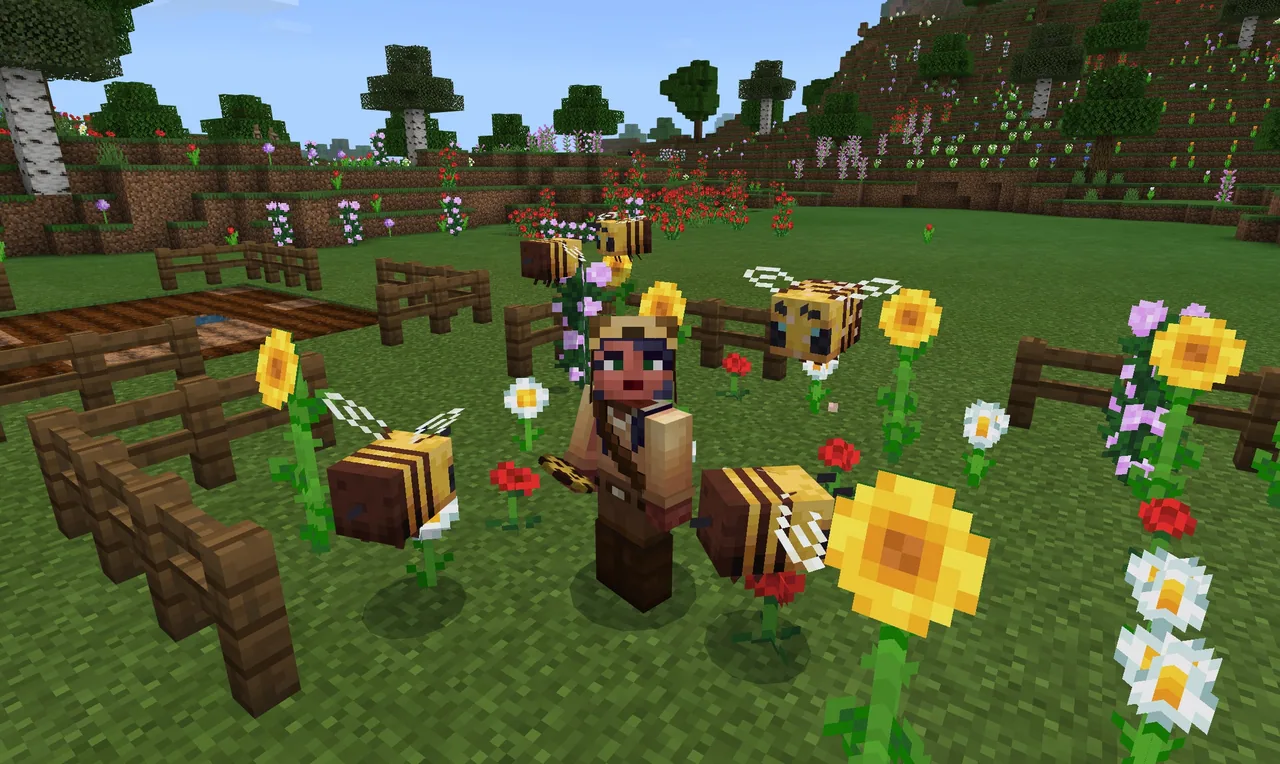
In this build challenge, students use Minecraft to design a pollinator garden filled with flowers and introduce honey bees. By planting crops nearby, learners observe the relationship between pollinators and agricultural production, reinforcing core science concepts through creative design.
Learning objectives
By the end of this activity students will be able to:
- Explain that honey bees pollinate roughly one third of human food crops.
- Describe how pollination allows plants to produce fruit in their life cycle.
- Design and construct a functional pollinator garden in Minecraft.
- Plant crops adjacent to the garden to observe the interaction with bees.
Blocks and items used in this lesson


Key vocabulary
- Pollination
- The process that enables flowering plants to reproduce and produce fruit.
- Pollinator
- An animal, such as a bee, that assists in the pollination of plants.
- Apiary
- A place where beehives are kept and cared for.
- Life Cycle
- The series of developmental stages a plant or animal experiences over time.
Before class
Lesson sequence
Suggested timing: about 60 minutes in total.
- Introduction and Discussion10 min
Introduce honey bees and explain that they pollinate about one third of the food we consume. Discuss why pollination is vital for plant life cycles and fruit production.
- Garden Planning10 min
Have students plan the layout of their pollinator garden, deciding which flowers to include and choosing an adjacent area for crop planting.
- Minecraft Build Challenge25 min
Students construct their pollinator gardens in Minecraft, introduce bees, and plant crops nearby to observe how the garden supports the bees.
- Review and Reflection15 min
Learners share their builds with classmates, explaining how their garden layout supports pollinators and what occurred when crops were planted nearby.
Assessment: success criteria
- Student builds a garden in Minecraft containing flowers and honey bees.
- Student plants crops near the garden to observe bee interactions.
- Student states that bees pollinate approximately one third of the food we eat.
- Student explains how pollination enables plants to produce fruit.
Differentiation
Allow students to work in pairs and focus on creating a simple floral plot with a single adjacent crop bed.
Incorporate beekeeping tools and non-player characters to develop the build into a sustainable farm and apiary.
Knowledge check
5 questions to check understanding after the lesson. Tap an answer to see if it is right; the score appears at the end.
1Roughly how much of the food humans eat is pollinated by bees?
Answer: C. The source specifies that bees pollinate approximately one third of the food we eat.
2Why is pollination an important part of a plant's life cycle?
Answer: A. Pollination allows many plants to produce fruit as part of their life cycle.
3What should students plant near their pollinator garden during the challenge?
Answer: D. The challenge prompts students to plant crops nearby and watch what happens.
4Which organization helped develop the Build With Bees lesson pack referenced in the extensions?
Answer: B. The extension notes that the pack was created with the American Beekeeping Federation's Kids and Bees program.
5What elements can students add to expand their build into an apiary and sustainable farm?
Answer: A. The extension suggests using new beekeeping tools and NPCs to create a sustainable apiary and farm.
Resources
Frequently Asked Questions
What subject areas does this build challenge address?
This activity focuses primarily on science, emphasizing plant reproduction, pollination, and ecosystems, while building communication, creativity, and critical thinking skills.
How can students extend their learning beyond the initial build?
Students can investigate local native bee species, design a real-world pollinator garden, expand their virtual farm into an apiary using NPCs, or complete the Build With Bees lesson series.
Adapted from Bee Creative! by Minecraft Education on Minecraft Education, last updated May 23, 2025. This classroom version, the timings and the quiz were written by 9Minecraft Education.