- Type
- Build challenge
- Duration
- about 60 min (suggested)
- Includes
- Quiz: 5 questionsMinecraft world
How can spatial design and intentional pathway choices create a functional, challenging labyrinth?
Overview
Labyrinths have appeared across history, literature, and art as complex spatial puzzles and cultural symbols. Designing an effective pathway requires careful spatial planning, intentional dead-ends, and an understanding of how an explorer navigates an enclosed environment.
In this lesson, students pair up to examine historical and visual examples of labyrinths before building their own in Minecraft. Once construction is complete, learners switch their game mode to survival, inviting their partner to test, navigate, and evaluate the route from a first-person perspective.
Learning objectives
By the end of this activity students will be able to:
- Research visual and historical examples of labyrinths to inform a layout.
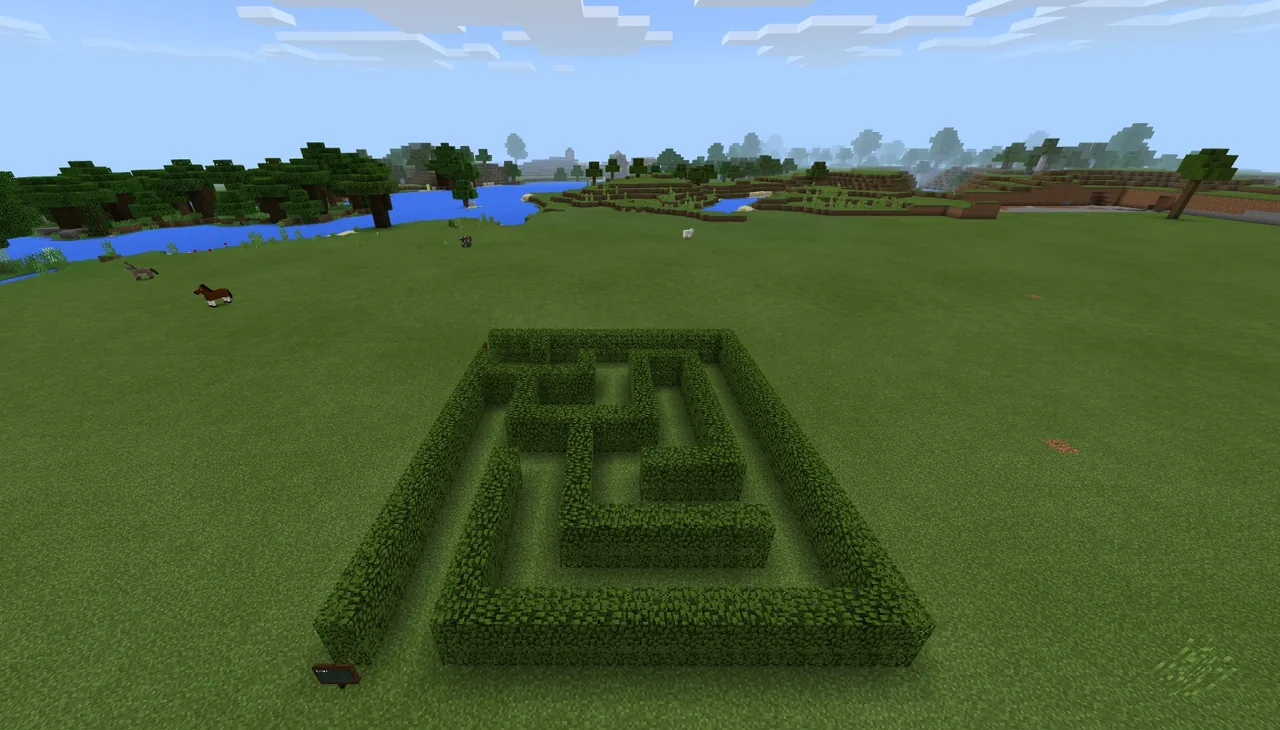
- Build a fully enclosed labyrinth in Minecraft with deliberate paths and dead-ends.
- Navigate and test a peer's labyrinth while playing in survival mode.
- Evaluate navigation difficulty and maze design through peer testing.
Blocks and items used in this lesson


Key vocabulary
- Labyrinth
- A complex network of winding paths, passages, or walls designed as a puzzle.
- Dead-end
- A passage or path in a maze that leads to no exit, forcing the explorer to turn back.
- Survival Mode
- A Minecraft game mode where players interact with standard physics, navigation constraints, and hazards without flying.
Before class
Lesson sequence
Suggested timing: about 60 minutes in total.
- Research and Discover10 min
Have students work in pairs to look up historical and modern examples of labyrinths in art, folklore, and design. Direct students to observe common patterns, wall placements, and path structures.
- Independent Construction25 min
Each student works in Minecraft to construct an original labyrinth. Students should establish walls, a starting entrance, branching corridors, and a final exit route.
- Survival Navigation Swap15 min
Partners swap worlds or join each other's builds. The builder switches the game setting to survival mode, and the visiting partner attempts to navigate from start to finish without flying.
- Review and Discussion10 min
Pairs discuss the experience of navigating each other's mazes, identifying which route choices caused disorientation and which landmarks aided navigation.
Assessment: success criteria
- The student researched and incorporated visual maze elements into their build.
- The student constructed a traversable labyrinth with a defined start, end, and pathway network.
- The student successfully switched the world to survival mode for peer navigation testing.
- The student provided constructive feedback to their partner regarding navigation difficulty.
Differentiation
Students who need help can sketch their path on graph paper first to map out turns and dead-ends before placing blocks.
Fast finishers can write an automated pathfinding program for the agent using Code Connection or embed distinct thematic features at dead-ends.
Knowledge check
5 questions to check understanding after the lesson. Tap an answer to see if it is right; the score appears at the end.
1What should students do before beginning their Minecraft labyrinth build?
Answer: B. The prompt instructs students to look up examples of labyrinths as the initial research step.
2Which game mode is used when partners navigate each other's labyrinths?
Answer: A. The challenge specifies switching to survival mode so the partner can attempt to navigate through.
3What planning technique is suggested as an extension to organize wall layouts?
Answer: C. The extensions explicitly suggest planning out the maze on graph paper prior to construction.
4How can Computer Science concepts be integrated into this labyrinth challenge?
Answer: D. The extension lists writing a program with Code Connection to guide the agent through the maze.
5Which core skills are highlighted in this build challenge?
Answer: B. The source identifies collaboration, creativity, and critical thinking as the target skills.
Resources
Frequently Asked Questions
Why is survival mode recommended for the testing phase?
Survival mode prevents players from flying over walls or breaking through barriers easily, ensuring they experience the maze strictly from the intended ground perspective.
Can students incorporate coding into this build challenge?
Yes. Students can use Code Connection to write programs that instruct the agent to autonomously traverse and solve the labyrinth corridors.
Adapted from The Labyrinth by Minecraft Education on Minecraft Education, last updated Sep 24, 2021. This classroom version, the timings and the quiz were written by 9Minecraft Education.