- Type
- Build challenge
- Subject
- Art, Music & Design
- Topics
- Art and Design
- Duration
- about 50 min (suggested)
- Includes
- Quiz: 5 questionsMinecraft world
How do repeating patterns and rhythm influence design in our everyday surroundings?
Overview
Patterns surround us across nature and human-made designs, shaping how we experience our everyday environments. Exploring repetition and rhythm helps students understand foundational principles of art and design while developing critical thinking about structure.
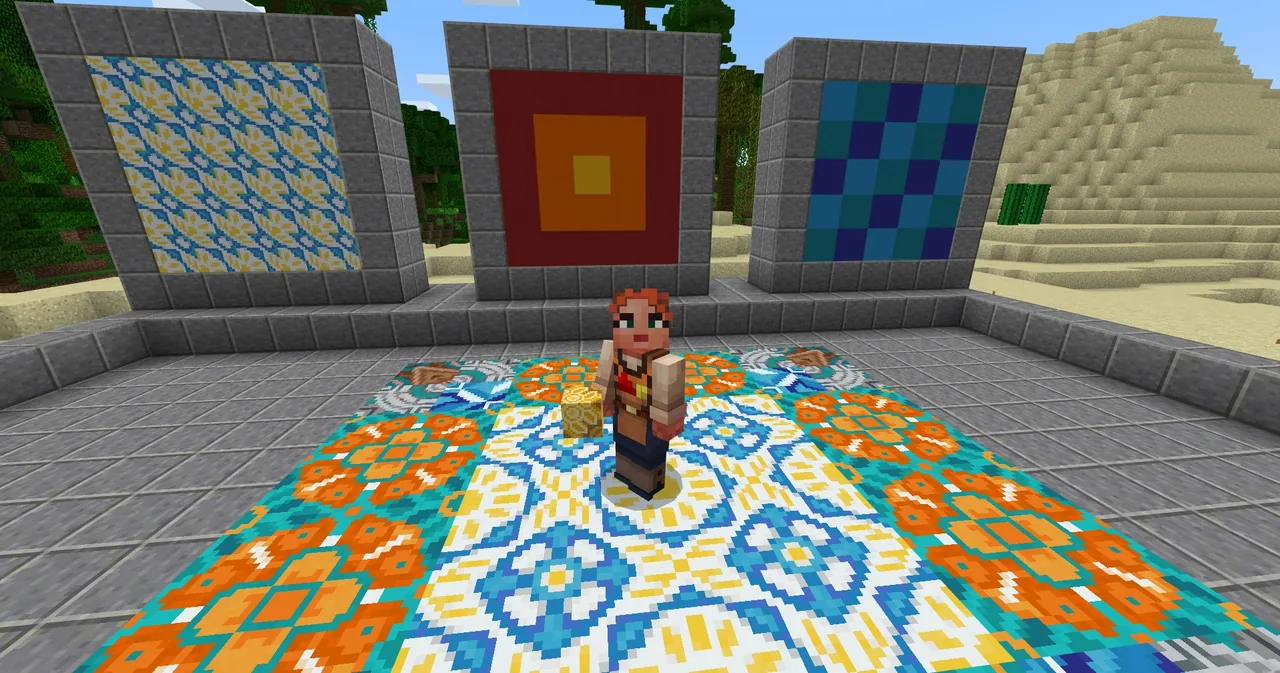
In this challenge, learners analyze how patterns influence daily life and apply those concepts directly inside Minecraft. By selecting blocks and organizing them into deliberate, repeating sequences, students practice creative problem-solving and visual planning.
Learning objectives
By the end of this activity students will be able to:
- Identify examples of patterns and repetition in the natural and designed world.
- Design and construct a repeating pattern or rhythm using blocks in Minecraft.
- Analyze how repeating visual motifs create structured aesthetic designs.
Blocks and items used in this lesson


Key vocabulary
- Pattern
- A regular, repeating sequence of shapes, lines, or colors.
- Repetition
- The technique of using the same visual element multiple times in a design.
- Rhythm
- A sense of movement or visual tempo created by organized repetition.
Before class
Lesson sequence
Suggested timing: about 50 minutes in total.
- Warm-up: Identifying Patterns10 min
Lead a class discussion asking students where they notice patterns in their everyday surroundings, including clothing, architecture, and nature. Introduce the concepts of repetition and visual rhythm.
- Build: Crafting Repeating Designs25 min
Students launch Minecraft and build an original repeating pattern using blocks of their choice. Encourage students to consider color, spacing, and consistent repetition as they construct their structures.
- Reflect and Extend15 min
Students share their creations with peers and explain the rule behind their pattern. Optional extension activities include having a partner complete an unfinished sequence or writing code for the Agent to place blocks automatically.
Assessment: success criteria
- Student identifies and explains the repeating sequence within their design.
- Student constructs a consistent, deliberate pattern or visual rhythm using blocks.
- Student describes how repeating elements function in everyday objects or natural structures.
Differentiation
Provide a simple two-block alternating sequence for the learner to continue before they develop their own pattern.
Have students write code to instruct the Agent to construct their repeating pattern automatically.
Knowledge check
5 questions to check understanding after the lesson. Tap an answer to see if it is right; the score appears at the end.
1Where does the challenge note that patterns can be found?
Answer: B. The challenge states that patterns exist all around us in both the natural and designed world.
2Which primary subject area does this build challenge address?
Answer: A. The source identifies Art and Design as the primary subject.
3Which of the following is suggested as an extension activity in the source?
Answer: D. The extensions explicitly suggest using a coding program to have the Agent build a pattern.
4What term describes the organized tempo or movement formed by repeating visual elements?
Answer: C. Rhythm in art refers to the visual movement or beat generated through repetition.
5What is the goal of the partner extension activity mentioned in the lesson?
Answer: A. The partner extension asks one student to start a pattern so the other can deduce it and finish the design.
Resources
Frequently Asked Questions
Can students collaborate during this build challenge?
Yes. The source highlights collaboration as a target skill and suggests a partner activity where students decipher and complete each other's repeating designs.
How can computer science be incorporated into this art lesson?
Students can use the Agent to program repeating block placement, connecting loops and algorithms directly to visual repetition and rhythm.
Adapted from Patterns, Repetition, Rhythm by Minecraft Education on Minecraft Education, last updated Jun 12, 2025. This classroom version, the timings and the quiz were written by 9Minecraft Education.