- Type
- Build challenge
- Duration
- about 75 min (suggested)
- Skills
- CollaborationCreativity
- Includes
- Quiz: 5 questionsMinecraft world
How can unexpected collaboration help us design unique creatures and stories?
Overview
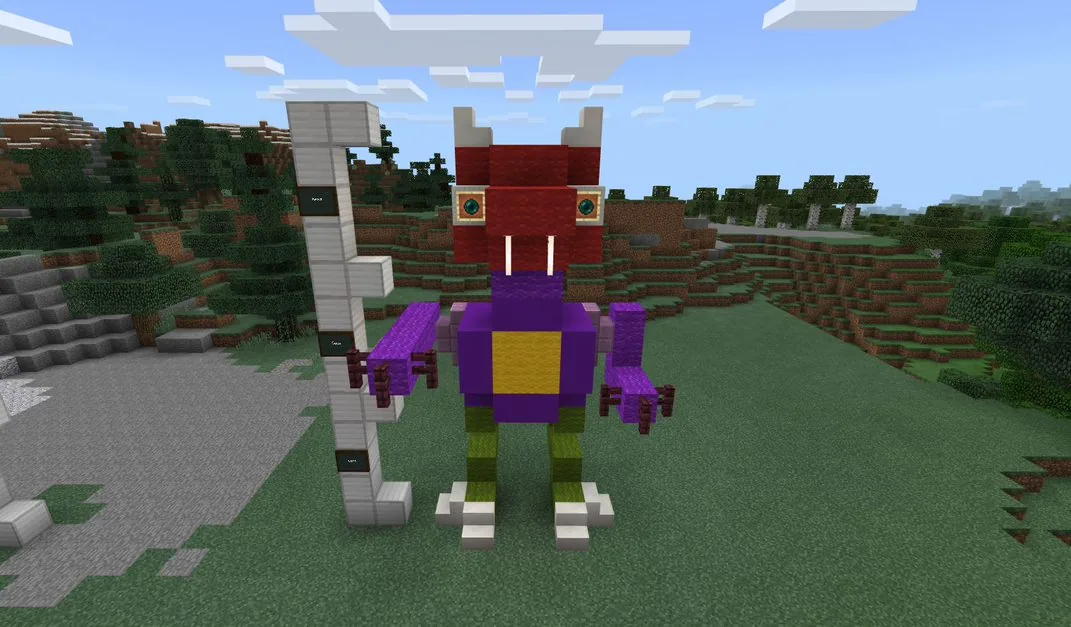
Monster Mashup is an interactive design challenge that relies on teamwork and imagination. Inspired by the classic surrealist drawing technique, three students combine their ideas into a single monster by building different anatomical sections in turn. This collaborative process encourages students to embrace unpredictable combinations and adapt their creative vision to match their peers' contributions.
Using Minecraft as a shared digital canvas, groups assign each member a starting position to construct the base or lower limbs of a creature. At designated intervals, students switch projects to add the torso and finally the head. The lesson integrates visual arts with literacy, prompting learners to draft imaginative narratives or research ancient mythical beasts once construction is complete.
Learning objectives
By the end of this activity students will be able to:
- Collaborate with peers in groups of three to build a composite creature.
- Design and construct specific anatomical parts of a monster across sequential rotation stages.
- Compose an original narrative or research mythic origins based on the completed build.
Blocks and items used in this lesson


Key vocabulary
- Collaboration
- Working together with other people to produce or create something.
- Torso
- The main part of a body, not including the head, arms, or legs.
- Structure Block
- A special block in Minecraft used to save, export, and load builds.
Before class
Lesson sequence
Suggested timing: about 75 minutes in total.
- Group Setup and Instructions10 min
Introduce the challenge rules and divide the class into groups of three. Explain that each member will start one creature by building the lower half, and builds will be traded to add new sections.
- Phase 1: Lower Body15 min
Each student begins on their own build site by creating the lower half of a monster. Encourage students to think about feet, legs, tentacles, or support structures.
- Phase 2: Torso Rotation15 min
Students rotate to the next build site within their trio. Each learner builds the torso and midsection directly on top of the lower body started by their teammate.
- Phase 3: Head Rotation15 min
Students rotate one final time to the third build site. They complete the creature by designing and building its head, face, and any upper features.
- Extensions and Creative Writing20 min
Teams review all three completed monsters. Students select one extension: write a short story detailing the monster's lore, research creatures from ancient mythology, or export the model using a structure block for mixed reality viewing.
Assessment: success criteria
- The student contributed cooperatively during each phase of the three-person build rotation.
- The finished model includes a recognizable lower section, torso, and head created across rotations.
- The student completed a follow-up story, myth research project, or structure block export.
Differentiation
Allow students to sketch a quick list of basic monster features before building to help guide their placement during timed rotations.
Challenge students to research a monster from world mythology and adapt its historical traits into their creative writing piece.
Knowledge check
5 questions to check understanding after the lesson. Tap an answer to see if it is right; the score appears at the end.
1How many students work together in each Monster Mashup build group?
Answer: B. The source states that students work in a group of three to collaboratively build a monster.
2Which section of the monster is constructed during the first build phase?
Answer: C. Each student begins the challenge by creating the lower half of the creature's body.
3What action do students take immediately after completing the lower body?
Answer: A. The source specifies that after creating the lower half, students switch and create the torso.
4Which Minecraft tool is suggested in the extensions to export the finished creature?
Answer: D. The extension recommends exporting the build with a structure block to view in Windows Mixed Reality.
5Which curriculum subjects are addressed by this collaborative challenge?
Answer: B. The source lists Art and Design along with Reading and Writing as the target subjects.
Resources
Frequently Asked Questions
How can students switch builds if they are not in the same Minecraft world?
If students cannot join a shared multiplayer world, they can physically switch seats at their computers when the rotation timer sounds.
What should students focus on during the writing extension?
Students write a short story that introduces their finished monster, detailing its personality, origins, and behavior.
Adapted from Monster Mashup by Minecraft Education on Minecraft Education, last updated Jun 12, 2025. This classroom version, the timings and the quiz were written by 9Minecraft Education.