- Type
- Build challenge
- Duration
- about 60 min (suggested)
- Includes
- Quiz: 5 questionsMinecraft world
How can introducing green spaces into an urban environment improve human wellbeing and combat urban heat islands?
Overview
Urban centers frequently experience elevated temperatures and reduced air quality due to dense infrastructure and limited vegetation. By studying urban heat islands and green spaces, students learn how introducing plant life into metropolitan areas can lower temperatures, improve environmental health, and foster human wellbeing.
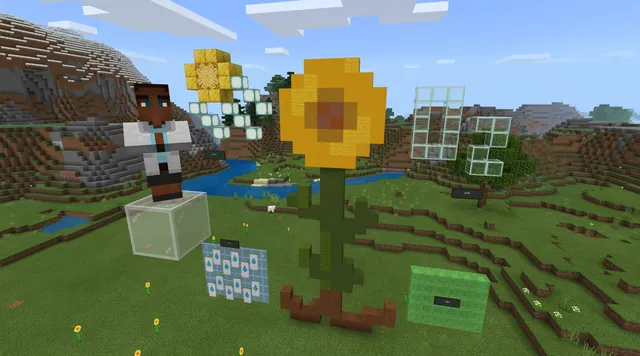
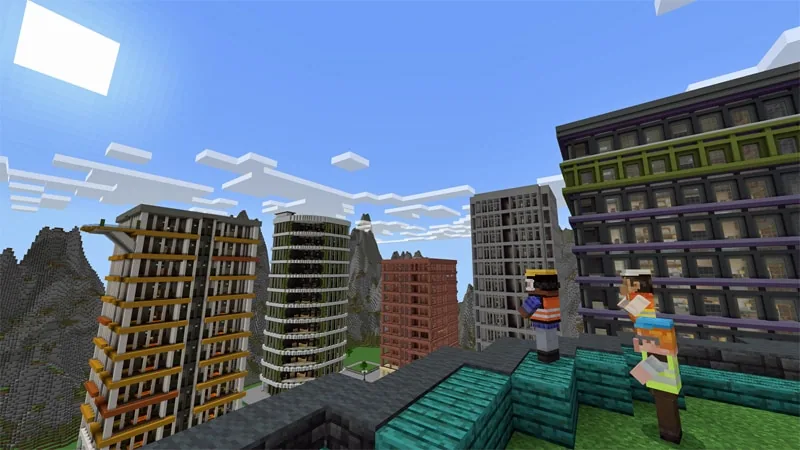
In this Minecraft Education challenge, learners take on the role of urban planners to transform paved city environments. Working individually or in teams, students design and construct plant-rich architectural elements, parks, and rooftop gardens to produce a healthier, more livable urban landscape.
Learning objectives
By the end of this activity students will be able to:
- Explain how urban heat islands impact city environments and human wellbeing.
- Identify methods of urban greening that can be applied to buildings and public areas.
- Design and construct green infrastructure within a Minecraft city environment.
- Collaborate with peers to propose sustainable solutions for built environments.
Blocks and items used in this lesson


Key vocabulary
- Urban Heat Island
- A metropolitan area that is significantly warmer than surrounding rural areas due to human activities and built infrastructure.
- Urban Greening
- The practice of adding public parks, street trees, green roofs, and gardens to cities to improve environmental quality.
- Wellbeing
- The state of being comfortable, healthy, or happy, which can be improved by access to nature and clean outdoor spaces.
- Green Space
- An area of grass, trees, or other vegetation set apart for recreational or aesthetic purposes in an urban environment.
Before class
Lesson sequence
Suggested timing: about 60 minutes in total.
- Discover10 min
Introduce the concepts of urban heat islands and green spaces. Discuss how dark asphalt, concrete, and lack of vegetation trap heat and affect community health in densely populated cities.
- Explore10 min
Have students load into the challenge world to examine the existing city architecture. Direct them to survey unshaded concrete areas, bare rooftops, and open pavement that could benefit from living vegetation.
- Build25 min
Students collaborate to transform city structures by building green roofs, vertical gardens, street-level planters, and community parks using natural blocks and water features.
- Reflect15 min
Learners showcase their greening projects to classmates, explaining how their design choices reduce local heat and enhance resident wellbeing.
Assessment: success criteria
- Student accurately identifies the primary causes and effects of urban heat islands.
- Student constructs functional green additions such as rooftop gardens, living walls, or community parks.
- Student articulates how their architectural modifications support community wellbeing and climate resilience.
Differentiation
Provide a basic checklist of specific green features to build, such as adding a simple tree canopy or rooftop garden plot to a single building.
Challenge students to automate their planting using the Agent, research native plants from their own area, or draft a greening proposal for their school campus.
Knowledge check
5 questions to check understanding after the lesson. Tap an answer to see if it is right; the score appears at the end.
1What is an urban heat island?
Answer: B. Urban heat islands occur when urban areas absorb and retain more heat than outlying rural areas.
2Which strategy directly contributes to urban greening?
Answer: A. Urban greening involves incorporating plant life and natural spaces into built environments.
3How does adding green spaces benefit residents living in urban areas?
Answer: D. Green spaces improve community wellbeing and provide cooling effects against high city temperatures.
4How can the Agent be used as an extension activity in this challenge?
Answer: B. The extension activity suggests using the Agent to assist in greening a building.
5What real-world connection can students explore as a follow-up project?
Answer: A. The source suggests extending learning by writing a proposal to green the school's buildings.
Resources
Frequently Asked Questions
Who designed the challenge world used in this lesson?
The Minecraft challenge world for this lesson was crafted by Piki Studios.
Can students incorporate coding into this build challenge?
Yes, students can complete an extension activity where they program the Agent to help green one of the city buildings.
Adapted from Greening Our City by Minecraft Education on Minecraft Education, last updated Oct 21, 2026. This classroom version, the timings and the quiz were written by 9Minecraft Education.