
- Type
- Lesson plan
- Includes
- Quiz: 5 questions
How do rectangular block arrays help us identify whether a number is prime or composite?
Overview
Understanding the distinction between prime and composite numbers is fundamental to mastering multiplication, division, and number theory. Students often struggle to understand why certain numbers cannot be evenly factored when working purely with abstract numerals on a worksheet.
In this lesson, learners use Minecraft blocks as hands-on manipulatives to build physical arrays. By attempting to construct rectangular grids for different quantities, students clearly see why composite numbers form neat blocks while prime numbers cannot be arranged into multi-row rectangles.
Learning objectives
By the end of this lesson students will be able to:
- Build rectangular arrays in Minecraft to model given quantities of blocks.
- Distinguish between prime and composite numbers based on array configurations.
- Explain why numbers such as 11 and 17 cannot form multi-row rectangular arrays.
Blocks and items used in this lesson


Key vocabulary
- Array
- An arrangement of objects in equal rows and columns.
- Composite Number
- A whole number greater than 1 that has more than two factors.
- Prime Number
- A whole number greater than 1 that has only two factors: 1 and itself.
Before class
Lesson sequence
- Warm-up Array Demonstration
Direct students to place blocks to form a 4 by 4 array in Minecraft. Gather the group to discuss how many total blocks were used (16) and how the rows and columns relate to factors.
- Modeling Composite Numbers
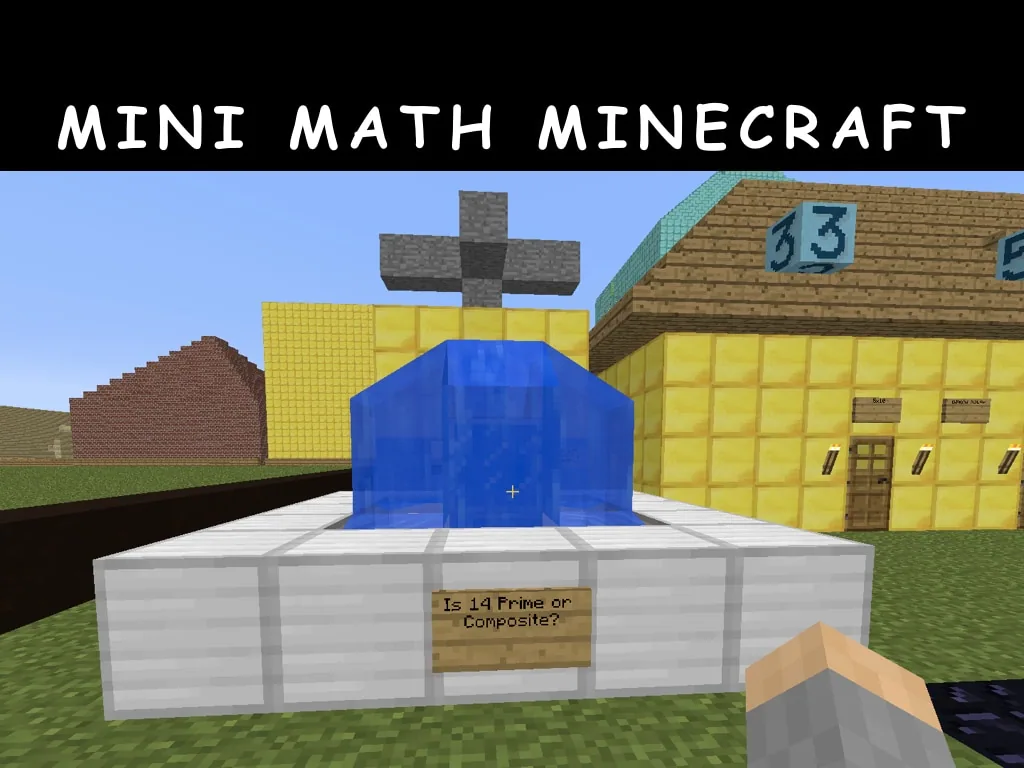
Instruct students to create rectangular arrays using specific block totals: 9, 14, 21, and 24. Once completed, facilitate a class discussion about what all of these numbers have in common regarding their shapes.
- The Prime Number Challenge
Ask students to construct rectangular arrays with block totals of 11 and 17. Allow time for exploration as students realize that these numbers cannot form multi-row rectangular grids.
- Discussion and Task Sharing
Discuss the formal definitions of prime and composite numbers based on student observations. Have learners complete the prime versus composite task and explain how they identify each number type.
Assessment: success criteria
- Student constructs accurate rectangular arrays for composite numbers such as 9, 14, 21, and 24.
- Student demonstrates through block placement that 11 and 17 cannot form multi-row rectangles.
- Student clearly articulates the difference between prime and composite numbers during class discussion.
Differentiation
Provide physical grid paper alongside Minecraft so students can sketch row-and-column options before placing blocks in-game.
Challenge students to find every possible rectangular array configuration for larger composite numbers like 24, 30, or 36.
Knowledge check
5 questions to check understanding after the lesson. Tap an answer to see if it is right; the score appears at the end.
1How many total blocks are used to construct a 4 by 4 array in Minecraft?
Answer: B. A 4 by 4 array consists of 4 rows of 4 blocks, which equals 16 blocks total.
2Which of the following numbers can be arranged into a multi-row rectangular array?
Answer: A. 14 is a composite number that can form a 2 by 7 array, whereas 11, 17, and 13 are prime.
3What did students discover when trying to build rectangular arrays for 11 and 17?
Answer: C. Because 11 and 17 are prime, they cannot be formed into rectangular arrays with dimensions greater than 1.
4What do the numbers 9, 14, 21, and 24 have in common in this lesson?
Answer: D. All four numbers have factors other than 1 and themselves, allowing them to form rectangular arrays.
5What mathematical property makes a number prime?
Answer: B. A prime number is defined as a number greater than 1 with only two factors: 1 and the number itself.
Frequently Asked Questions
Do I need a special world file to teach this lesson?
No special world download is required. Any standard Creative mode or Flat world allows students to place blocks freely to build their arrays.
Can a 1 by 11 line of blocks be considered an array?
While a single row of 11 blocks mathematically represents a 1 by 11 arrangement, the lesson focuses on building multi-row rectangular arrays to show factors greater than 1.
Adapted from MMW: Prime Vs. Composite by Joe Beasley on Minecraft Education, last updated Jul 12, 2018. This classroom version, the timings and the quiz were written by 9Minecraft Education.