
- Type
- Lesson plan
- Duration
- about 80 min (suggested)
- Includes
- Quiz: 5 questions
How can modular architecture and repurposed shipping containers solve emergency hospital shortages during a pandemic?
Overview
During major viral outbreaks, traditional medical centers often face severe shortages of intensive care space. To address this crisis, architects Carlo Ratti and Italo Rota, alongside the MIT Senseable City Lab, designed CURA (Connected Units for Respiratory Ailments). These mobile biocontainment pods repurpose standard shipping containers into rapidly deployable, two-patient intensive care units equipped with negative pressure ventilation to protect healthcare workers.
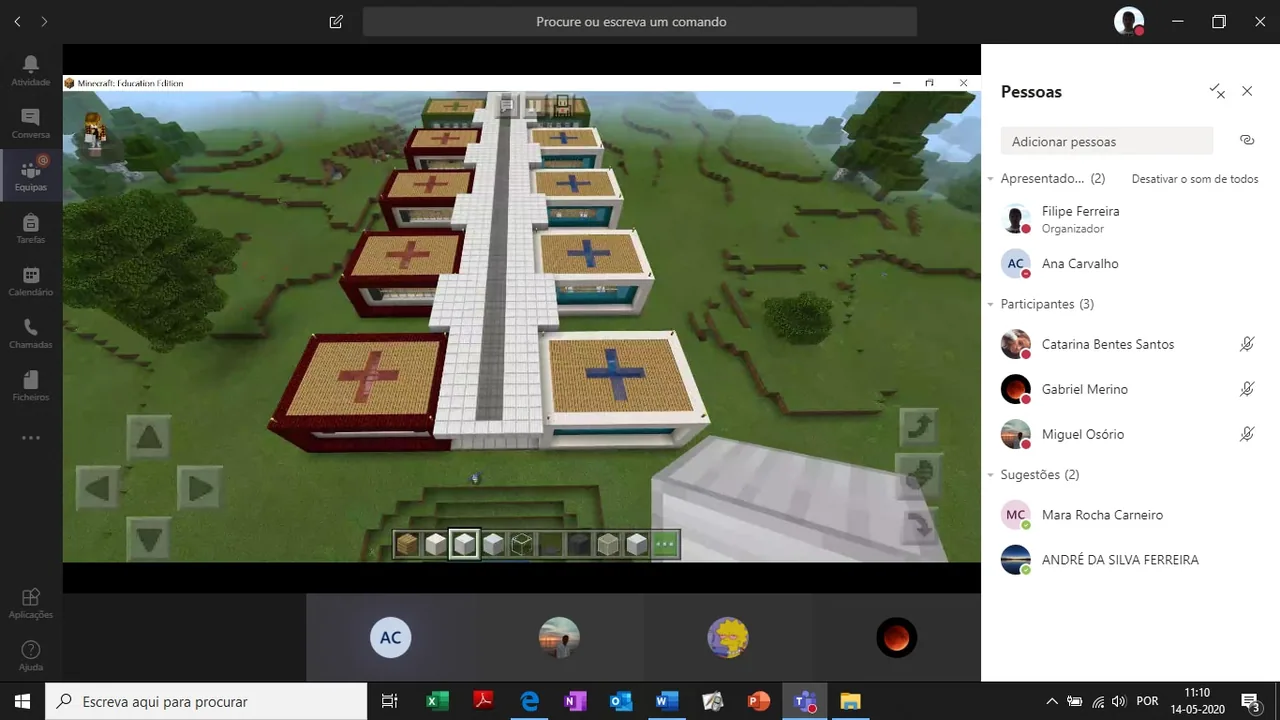
In this project-based learning activity, students examine the engineering and architectural requirements of emergency field hospitals. Using Minecraft, learners plan and construct their own modular field hospital systems, translating real-world container dimensions and biocontainment design principles into functional medical facilities.
Learning objectives
By the end of this lesson students will be able to:
- Explain the architectural advantages and medical functions of modular CURA biocontainment pods.
- Plan a field hospital layout that accommodates rapid deployment, patient capacity, and worker safety.
- Construct a modular shipping container ICU in Minecraft featuring biocontainment measures and expandable units.
Blocks and items used in this lesson


Key vocabulary
- CURA
- Connected Units for Respiratory Ailments; modular intensive care pods built from repurposed shipping containers.
- Negative Pressure
- A ventilation system design that stops contaminated indoor air from leaking into surrounding areas.
- Biocontainment
- Physical containment methods used to keep infectious diseases safely isolated.
- Modular Architecture
- A building method where standardized units are prefabricated and connected into larger facilities.
Before class
Lesson sequence
Suggested timing: about 80 minutes in total.
- Case Study & Architectural Brief15 min
Introduce the real-world challenge of ICU shortages during pandemics. Present the MIT CURA proposal, discussing how repurposed 6.1-meter shipping containers provide rapid, transportable biocontainment units for two patients while using negative pressure ventilation to shield medical staff.
- Layout Planning15 min
Have students sketch their field hospital designs individually or in small teams. Students must plan the placement of two beds per pod, outline ventilation zones, and determine how individual pods will connect into larger complexes using inflatable structures.
- Minecraft Construction35 min
Students enter Minecraft to build their emergency field hospital. They must fulfill the following criteria:
- Build shipping container pods matching the 6.1-meter scale (approx. 6-8 blocks long).
- Equip each pod as a two-bed biocontainment intensive care unit.
- Incorporate negative pressure ventilation details and connectors to expand the hospital.
- Site Review & Reflection15 min
Conduct a virtual walkthrough of student facilities. Groups explain how their structures can be quickly transported by road, rail, or ship to medical hot spots and how their modular layouts adapt to parking lots or open fields.
Assessment: success criteria
- Hospital structures clearly reflect the dimensions and modular nature of repurposed 6.1-meter shipping containers.
- Each ICU biocontainment pod correctly incorporates accommodation for two patients.
- Design addresses biocontainment requirements, including negative pressure ventilation concepts.
- The facility demonstrates modular expansion capabilities through interconnecting corridors or structures.
Differentiation
Provide a block template showing the basic outer footprint and bed placement for a single two-patient shipping container.
Have students design an expanded regional medical center that connects multiple pods with inflatable transit corridors and integrates into an existing parking area.
Knowledge check
5 questions to check understanding after the lesson. Tap an answer to see if it is right; the score appears at the end.
1What does the medical acronym CURA stand for?
Answer: A. According to the source, CURA stands for Connected Units for Respiratory Ailments.
2What structure is repurposed to build each CURA intensive care unit pod?
Answer: B. The project uses repurposed 6.1-meter-long shipping containers to house the pods.
3How many patients is each individual CURA pod designed to hold?
Answer: C. The CURA biocontainment pods serve as an intensive care unit for two patients at a time.
4What is the primary function of the negative pressure ventilation system inside the pod?
Answer: B. Negative pressure prevents contaminated air from leaking out, lowering infection risks for medical staff.
5How can multiple CURA pods be linked together to create a larger field hospital?
Answer: C. The source explains that multiple pods can be joined with an inflatable structure to form a larger center.
Frequently Asked Questions
Do I need a custom world file to teach this lesson?
No custom world download is required. Teachers can use a basic flat world or an open creative world with clear space for students to arrange their container units.
What block scale works best for representing shipping containers?
Because the real units are roughly 6.1 meters long by 2.5 meters wide, building footprints of roughly 6 to 8 blocks long by 3 blocks wide provides an accurate in-game proportion.
Where are these emergency hospitals designed to be placed in real life?
They are designed to operate as stand-alone field hospitals or as rapid expansions deployed directly in the parking lots of existing hospitals.
Adapted from Emergency campaign hospital by Filipe Ferreira on Minecraft Education, last updated May 18, 2020. This classroom version, the timings and the quiz were written by 9Minecraft Education.