
- Type
- Lesson plan
- Includes
- Quiz: 5 questions
How do bees facilitate plant reproduction, and what sustainable environments can we design to support them?
Overview
Students explore the essential role of bees in plant reproduction by investigating floral anatomy, pollination mechanisms, and hive structures. Through a series of guiding inquiry questions, learner teams research how pollen transfers between reproductive organs and examine real-world challenges facing bee populations.Learning objectives
By the end of this lesson students will be able to:
- Identify the reproductive parts of a flower, including stamens and pistils, and describe how pollination occurs.
- Explain the ecological relationship between bees, nectar, and pollination agents.
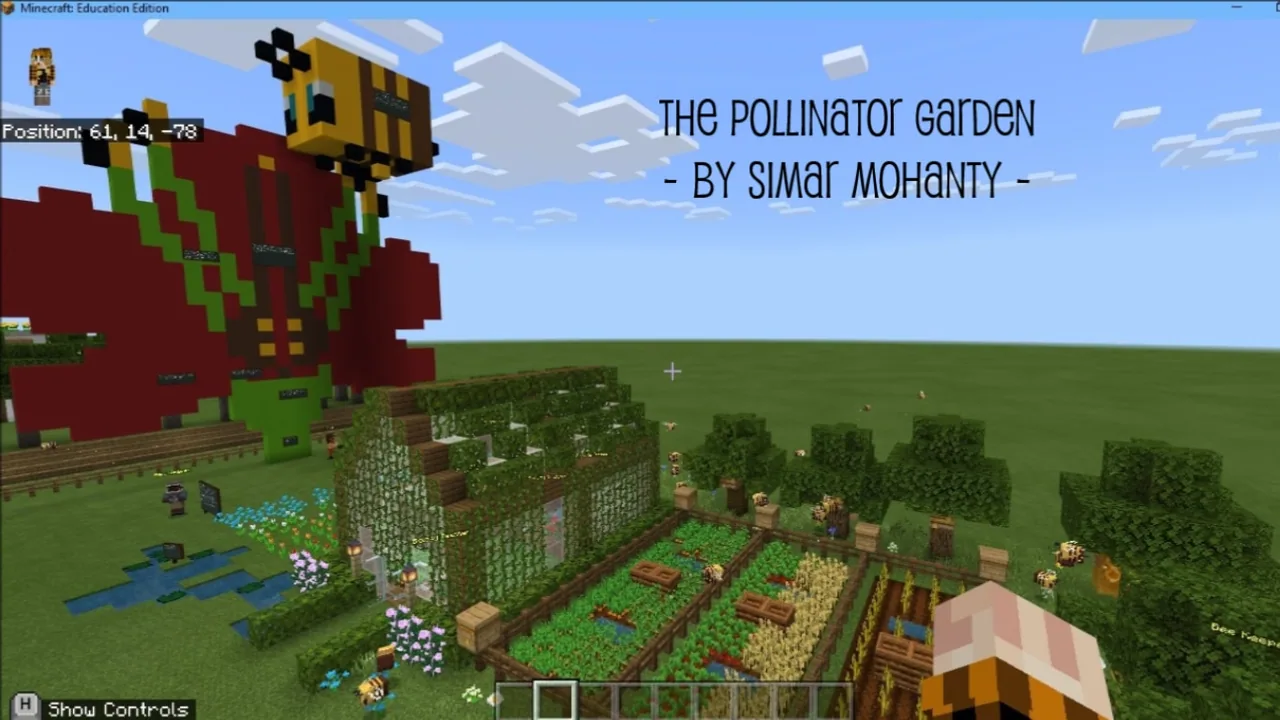
- Build sustainable models block-by-block in Minecraft, including pollinator gardens and apiaries, using narrative tools.
- Document scientific evidence in a curated bibliography and present findings through a recorded video walkthrough.
Blocks and items used in this lesson
 Bee
 Chalkboard
 Honeycomb
Key vocabulary
- Pollination
- The process of transferring pollen from male reproductive structures to the female stigma of a plant.
- Stamen and Pistil
- The male (stamen) and female (pistil) reproductive organs of a flowering plant.
- Nectar
- A sweet, sugar-rich fluid produced by flowers to attract pollinators like bees.
- Apiary
- A location where managed beehives and honeycombs are maintained.
- Pollinator Garden
- A dedicated garden space planned with specific plants to attract and nourish pollinators.
Before class
Lesson sequence
- Inquiry and Research
Introduce the project questions to student teams. Working remotely or collaboratively in Microsoft Teams, students research four guiding questions per week regarding plant reproduction, pollination types, and bee behaviors.
Teams log their progress in their OneNote Class Notebook and compile their research sources into a Wakelet bibliography.
- Collaborative World Building
In multiplayer mode, teams take the scientific concepts they researched and construct sustainable answers block-by-block inside the Minecraft world.
Students build models representing flower anatomy, bee habitats, apiaries, and effective pollinator gardens to address depleting bee populations.
- In-Game Documentation
Teams integrate in-game narrative and creative tools to explain their builds to visitors. Students place boards, posters, slates, signs, and non-player characters (NPCs) alongside their structures to provide scientific context and descriptions.
- Walkthrough and Knowledge Check
Each team records a virtual tour of their completed Minecraft world using Flipgrid, verbally presenting their design choices and scientific findings.
Conclude the unit with a Kahoot quiz to evaluate individual student mastery of the science content.
Assessment: success criteria
- Correct depiction of plant reproductive structures and pollination concepts within the Minecraft build.
- Completed OneNote notebook updates and a well-curated Wakelet bibliography of scientific evidence.
- Clear, informative Flipgrid walkthrough explaining the team's sustainable creations.
- Scoring at least 90% on the final Kahoot quiz covering lesson content.
Differentiation
Assign specific inquiry questions to individual group members and provide a basic layout checklist for the pollinator garden.
Have advanced learners analyze the medicinal properties of honey components and optimize their pollinator garden for diverse pollinator species.
Knowledge check
5 questions to check understanding after the lesson. Tap an answer to see if it is right; the score appears at the end.
1Which flower parts serve as the male and female reproductive structures?
Answer: B. Stamens are the male reproductive organs and pistils are the female reproductive organs in a flower.
2What sweet substance produced by flowers attracts bees to act as pollinators?
Answer: C. Flowers produce nectar to encourage visits from pollinators like bees.
3What is the proper term for a collection of beehives kept by beekeepers?
Answer: D. An apiary is a location where beehives are established and cared for.
4Which Minecraft tools are used to add scientific signage and text explanations to student builds?
Answer: A. The source specifies slates, posters, boards, signs, and NPCs as the narrative tools for documenting answers in-game.
5How do student teams record and share their final Minecraft world walkthrough?
Answer: B. The lesson directs students to record a walkthrough of their Minecraft world using Flipgrid.
Frequently Asked Questions
How is the project schedule organized across multiple weeks?
The unit features 12 research questions designed to be addressed at a steady pace of four questions per week, allowing students to research, plan, and build progressively.
Which digital tools are required alongside Minecraft: Education Edition?
The unit integrates Microsoft Teams for communication, OneNote Class Notebook for progress tracking, Wakelet for bibliographies, Flipgrid for walkthroughs, and Kahoot for quizzes.
What is the expected benchmark for the final assessment?
According to the lesson expectations, most students should aim to achieve a score of at least 90% on the concluding Kahoot quiz.
Adapted from Bees - Science@Minecraft by 71BBB635-2EA2-4A65-A1F9-F96E5CD3519D 71BBB635-2EA2 on Minecraft Education, last updated Feb 24, 2022. This classroom version, the timings and the quiz were written by 9Minecraft Education.