
- Type
- Lesson plan
- Duration
- about 60 min (suggested)
- Includes
- Quiz: 5 questions
How do we distinguish between the surface area of a space and its total volume?
Overview
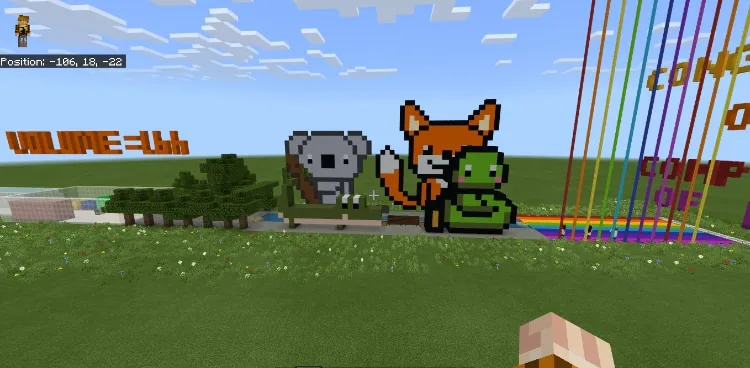
Understanding the distinction between two-dimensional surface coverage and three-dimensional spatial capacity is a cornerstone of geometry. In this lesson, learners compare area and volume while reviewing fauna endemic to Australia, connecting mathematical problem-solving to animal habitats and living environments.Learning objectives
By the end of this lesson students will be able to:
- Differentiate clearly between the definitions of area and volume.
- Calculate area and volume by counting blocks and applying mathematical formulae.
- Document solutions using in-game cameras, question chalkboards, or a Book and Quill.
- Apply area and volume formulae to solve word problems within the world.
Blocks and items used in this lesson


Key vocabulary
- Area
- The number of square units needed to cover a flat surface.
- Volume
- The measurement of capacity expressed in cubic units.
- Endemic Fauna
- Animals that are native to and naturally found only within a specific geographical area, such as Australia.
Before class
Lesson sequence
Suggested timing: about 60 minutes in total.
- Warm-up and Concept Introduction10 min
Introduce the lesson topic and run an ice-breaker discussion asking students to contrast area and volume. Clarify that area represents square units covering a surface, while volume measures capacity in cubic units, referencing Australian wildlife habitats as context.
- World Exploration and Puzzle Solving25 min
Students load the supplied Minecraft world, which provides a visual representation of these mathematical ideas. Learners navigate to numbered puzzle stations, counting blocks and applying mathematical formulae to solve each area and volume problem.
- Documentation and Gem Collection15 min
Students write down answers on paper or question chalkboards, capturing evidence with the camera or taking screenshots. They may also record final answers in a Book and Quill placed in chests, earning in-game gems as each puzzle is successfully solved.
- Review and Reflection10 min
Gather the class to review solutions to the word problems and address common misconceptions between square and cubic measurements. Celebrate learners who gathered all gems and demonstrated sound mathematical thinking.
Assessment: success criteria
- Student accurately explains the difference between area and volume.
- Student correctly calculates area and volume using block counting and mathematical formulae.
- Student applies mathematical formulae to resolve lesson word problems.
- Student provides recorded evidence of solutions via chalkboards, screenshots, or a Book and Quill.
Differentiation
Allow learners to directly count visible block surfaces and unit blocks before introducing multiplication formulae.
Have students tackle complex word problem stations independently and verify peer calculations for speed and accuracy.
Knowledge check
5 questions to check understanding after the lesson. Tap an answer to see if it is right; the score appears at the end.
1What is area defined as in this lesson?
Answer: B. The lesson defines area as the number of square units needed to cover a particular surface.
2How does the lesson define volume?
Answer: A. Volume is explicitly defined as the measurement of capacity in cubic units.
3Which scientific topic is reviewed alongside area and volume in this world?
Answer: C. The lesson combines math concepts with a review of fauna endemic to Australia.
4What do students collect inside the game for each puzzle they solve?
Answer: D. The student activities state that learners earn in-game gems for each puzzle they complete.
5Which method can students use to document their final answers in the game?
Answer: B. Students can record their final answers using a Book and Quill stored in designated chests.
Frequently Asked Questions
What documentation methods are available for students to show their work?
Students can write their calculations on paper, write them on in-game question chalkboards and capture a screenshot or camera photo, or enter final answers into a Book and Quill placed in chests.
How can teachers handle students with varying math proficiencies?
Beginners can find area and volume by counting individual blocks visually, while more advanced learners can apply mathematical formulae to solve both standard puzzles and word problems.
Adapted from Area & Volume - Math@Minecraft by 71BBB635-2EA2-4A65-A1F9-F96E5CD3519D 71BBB635-2EA2 on Minecraft Education, last updated Feb 22, 2022. This classroom version, the timings and the quiz were written by 9Minecraft Education.